The State of Call Center Outsourcing in 2026: Trends, AI Adoption & Industry Benchmarks
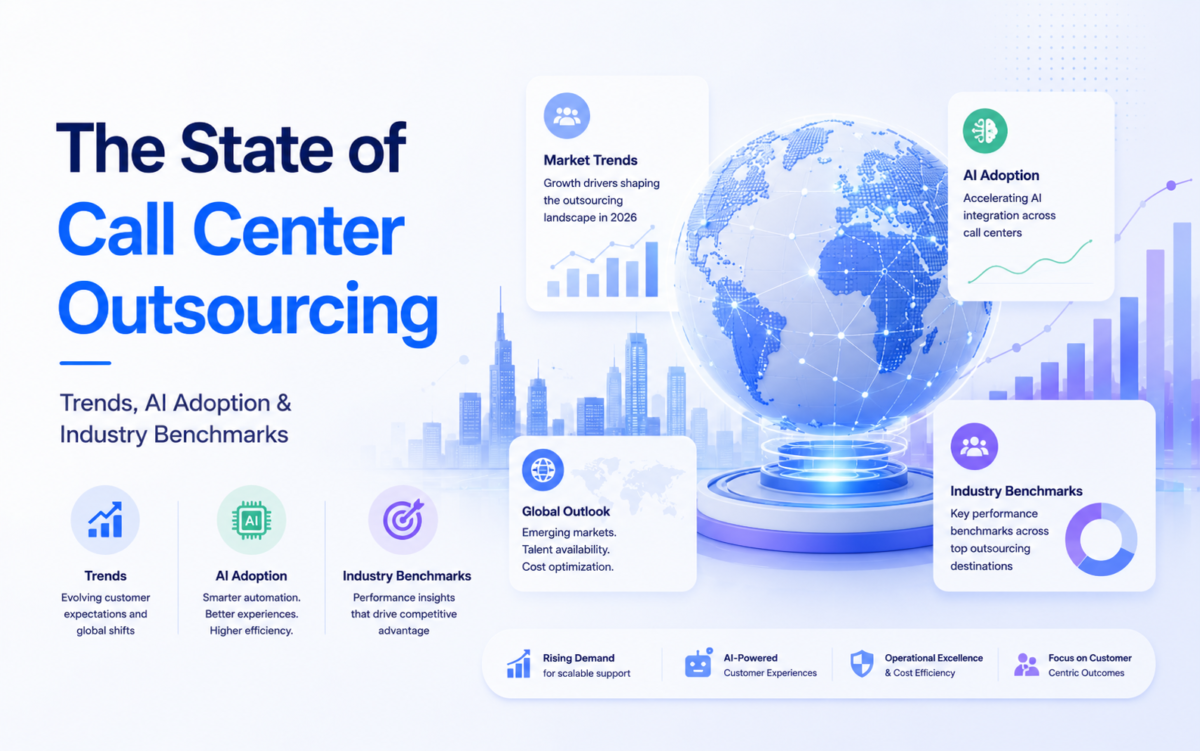
Call center outsourcing in 2026 is being reshaped by one dominant force — artificial intelligence — alongside steady market growth, a shift toward flexible and hybrid delivery models, and rising expectations around omnichannel service, compliance, and agent experience. The industry is not shrinking despite automation; it’s restructuring. AI is absorbing routine, high-volume work while human agents move toward complex, higher-value interactions, and outsourcing continues to grow faster than in-house operations. This report summarizes the key trends, AI adoption data, and industry benchmarks defining call center outsourcing in 2026, drawn from current market research.
Key Takeaways
- AI is the defining trend of 2026: Gartner projects conversational AI will reduce contact center agent labor costs by $80 billion in 2026.
- The outsourcing market continues to grow, with industry forecasts putting it around $380+ billion in 2026 and expanding at roughly 9% annually.
- Automation is restructuring, not replacing, the workforce — AI handles routine volume while human agents shift to complex, higher-value work.
- Hybrid models that blend AI efficiency with human empathy are outperforming both pure-automation and pure-human approaches.
- India remains a central global hub, combining scale, deep talent, and cost advantage, increasingly extended into AI-adjacent services.
The Big Picture: A Growing, Restructuring Industry
The call center outsourcing market remains large and growing in 2026. Industry forecasts place the global market in the region of $380 billion in 2026, expanding at roughly a 9% compound annual growth rate over the following years — with outsourced operations growing faster than in-house centers. At the same time, spending is shifting: the contact center software and AI segments are growing far faster than the overall market, as companies invest heavily in cloud platforms and AI-powered tools.
The headline story of 2026, then, isn’t growth or decline — it’s restructuring. Money that once went almost entirely to headcount is increasingly split between people and technology. The result is an industry doing more volume with a different mix of human and automated labor.
AI Adoption: The Defining Trend of 2026
Artificial intelligence is the single most important force in the industry this year. The most-cited figure comes from Gartner: by 2026, conversational AI deployments within contact centers will reduce agent labor costs by $80 billion, according to the firm. That projection is striking given the context Gartner provides — it estimates roughly 17 million contact center agents worldwide, with labor representing up to 95% of contact center costs.
What makes the figure even more notable is how modest the underlying automation rate is: Gartner projects that just one in ten agent interactions will be automated by 2026, up from around 1.6% previously. In other words, even a relatively small share of automated interactions, applied across a workforce of millions, produces tens of billions in cost displacement — precisely because labor dominates contact center economics.
The practical takeaway for 2026 is that AI has moved from experiment to standard operating practice. AI now handles routine, repetitive queries and assists human agents in real time, while the hardest, most sensitive interactions remain firmly human.
How AI Is Changing the Work (Not Eliminating It)
The narrative that AI is simply replacing call center jobs misreads what’s actually happening. The clearer picture is a restructuring of the workforce toward higher-skilled, higher-value roles, while AI handles the volume-based work that previously required large teams of generalist agents.
In practice, AI in 2026 shows up across the operation in several ways:
- Customer-facing automation — chatbots and virtual agents resolve routine, high-frequency queries before they reach a human.
- Real-time agent assist — AI surfaces relevant information, suggests responses, and guides agents during live interactions, improving speed and consistency.
- Quality and analytics — AI powers automated quality monitoring, sentiment analysis, and predictive insights across far more interactions than manual review could cover.
- Back-office automation — post-interaction tasks and CRM updates are streamlined, reducing after-call work.
The consistent finding across the industry is that hybrid models — AI efficiency paired with human empathy — outperform both pure automation and pure human approaches. For more on the tools driving this, see our guide to the AI tools every call center should be using and our look at the future of AI-powered voice and chat assistance.
The Major Trends Shaping Outsourcing in 2026
Beyond AI, several connected trends define the industry this year:
- Flexibility over fixed infrastructure. Companies are moving away from large, fixed in-house operations toward flexible, scalable capacity — a major driver of outsourcing growth, since partners absorb volume swings without permanent overhead.
- Omnichannel as the baseline. Customers expect to move between phone, chat, email, and social without repeating themselves. Unified, context-aware omnichannel support is now an expectation, not a differentiator.
- Compliance and security as competitive advantages. With more regulation around data and offshore handling, strong security and compliance practices have become a reason buyers choose one provider over another, not just a checkbox.
- Agent experience and retention. With agent attrition a persistent industry challenge, providers are investing in agent well-being and engagement, recognizing that turnover directly degrades customer experience and inflates cost.
- Proactive, data-driven CX. Predictive analytics and sentiment analysis are replacing purely reactive metrics, letting operations anticipate issues rather than just respond to them.
Industry Benchmarks to Know in 2026
A few widely referenced operational benchmarks help contextualize performance this year:
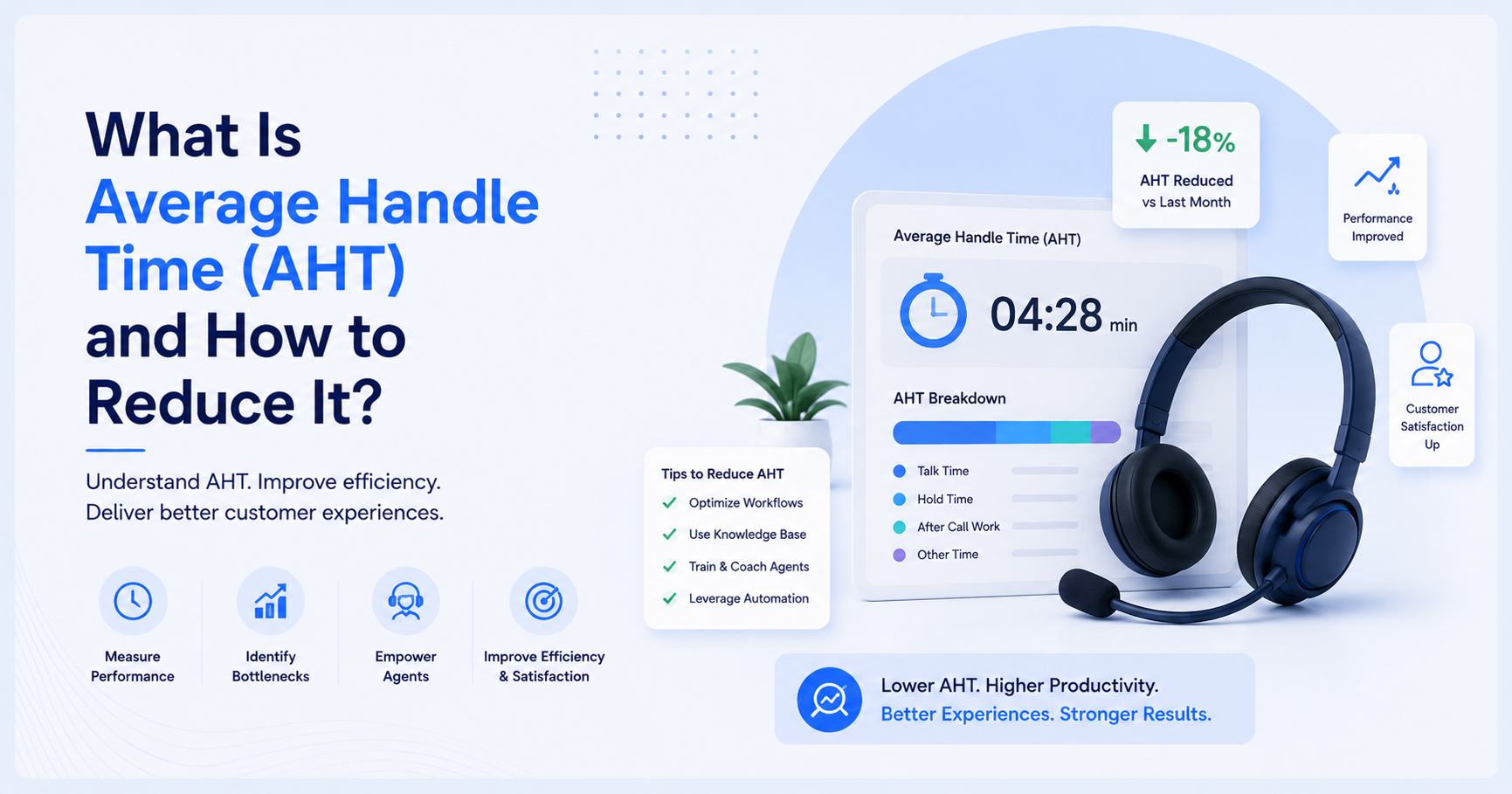
- Average Handle Time (AHT): the commonly cited industry benchmark sits around six minutes, though it varies widely by industry and complexity.
- First Contact Resolution (FCR): an industry-wide average of roughly 70% is frequently referenced as a healthy target.
- Agent attrition: turnover remains high across the industry, commonly cited in the 30–45% annual range and higher in some markets — one of the sector’s most persistent challenges.
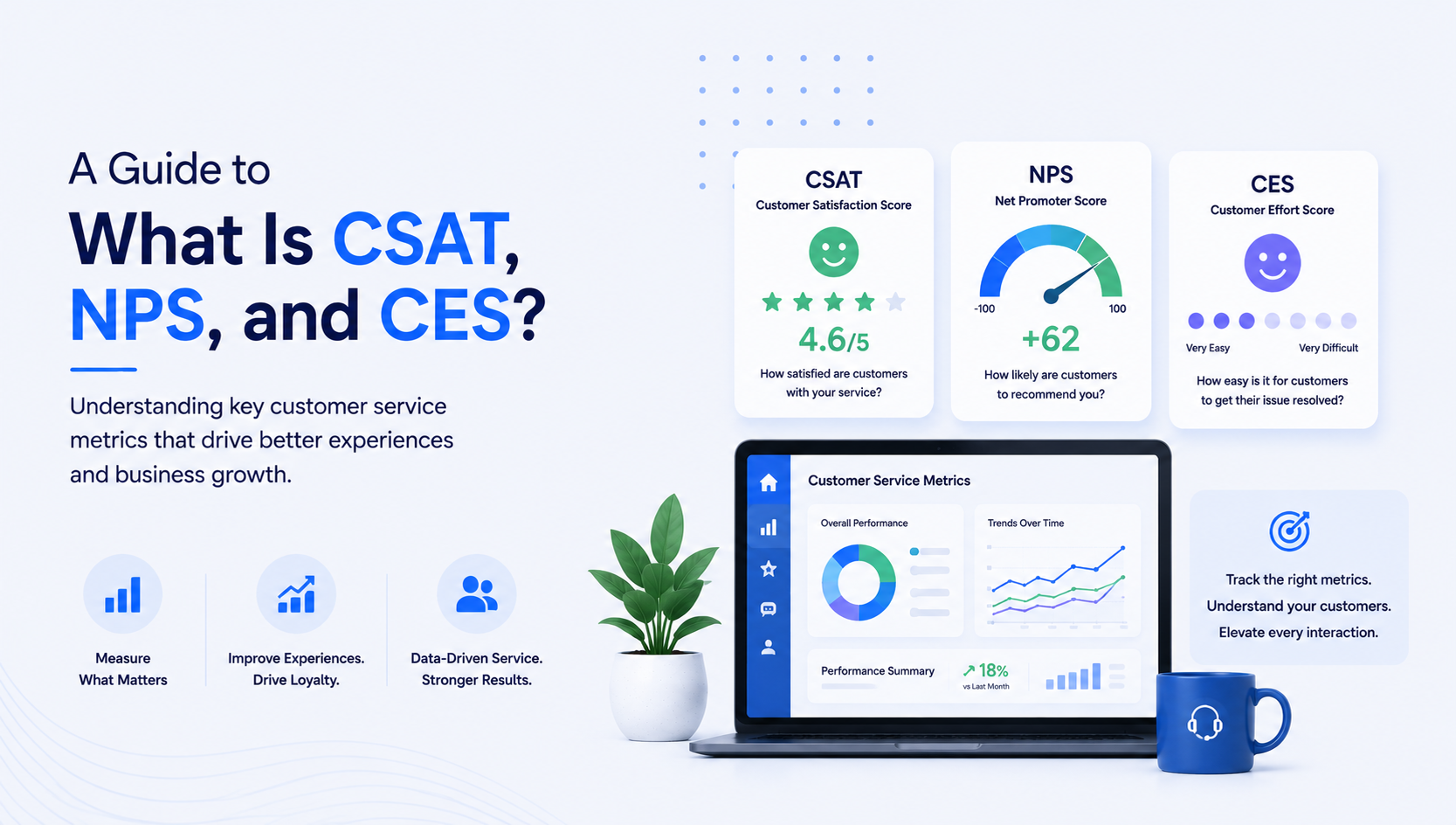
These are reference points, not universal truths — the right targets depend heavily on industry, channel, and the complexity of the work. For deeper explanations, see our guides on average handle time, first call resolution, and the customer experience metrics (CSAT, NPS, CES) that round out a complete performance picture.
India’s Position in the 2026 Landscape
India remains one of the world’s central hubs for call center and BPO outsourcing in 2026. Its enduring advantages — a vast, English-speaking, university-educated workforce, decades of mature delivery infrastructure, and a strong cost position — continue to make it a default destination for high-volume voice and non-voice support.
What’s notable in 2026 is how India’s role is evolving alongside the AI shift. Rather than being threatened by automation, leading Indian providers are extending into the higher-value and AI-adjacent work the new landscape demands — including data annotation, analytics, and AI-supported customer operations. As AI handles tier-one volume, the human work that remains is more complex and higher-value, which plays to India’s deep talent pool. For a fuller cost picture, see our 2026 India pricing benchmarks.
What This Means for Businesses Evaluating Outsourcing
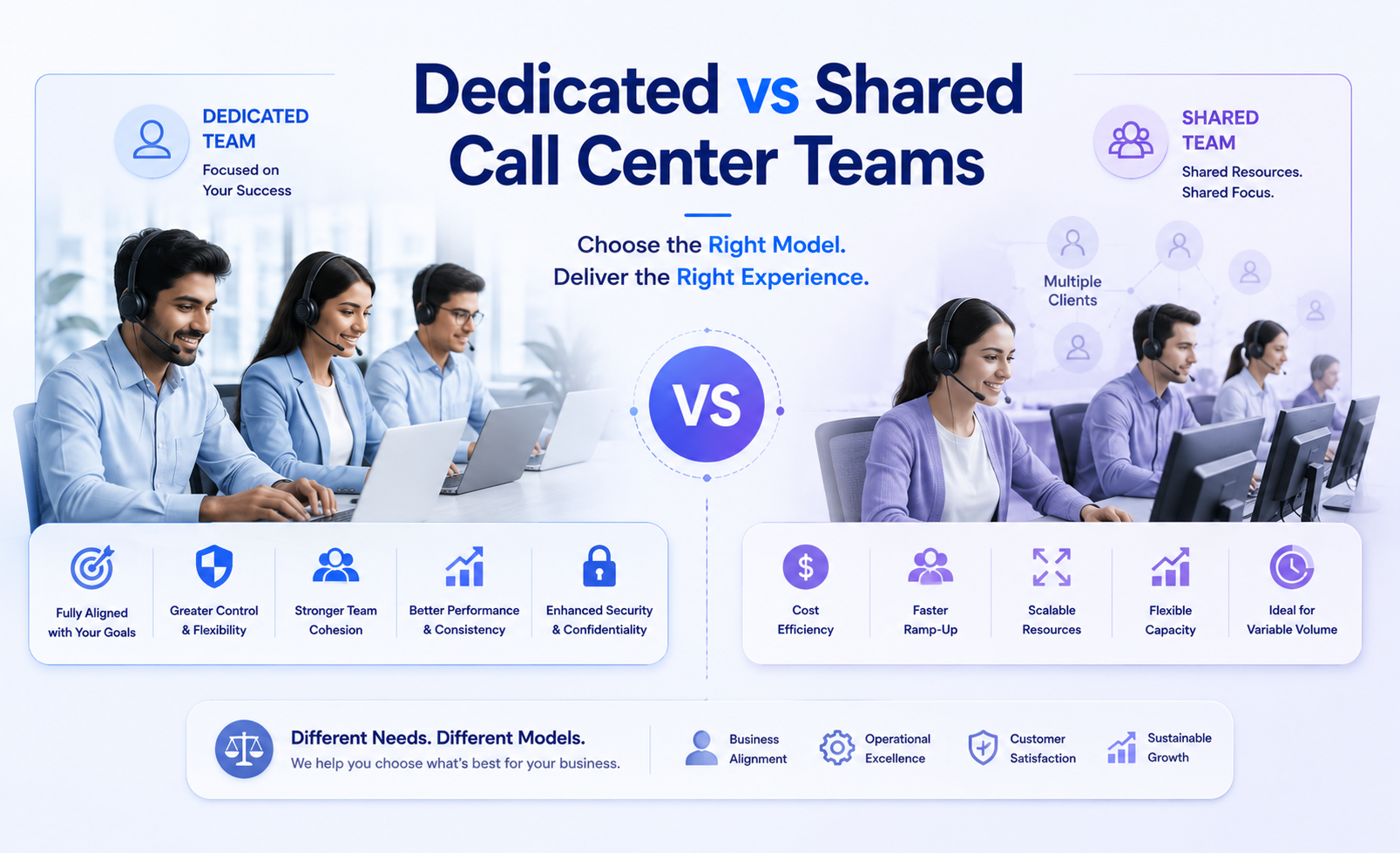
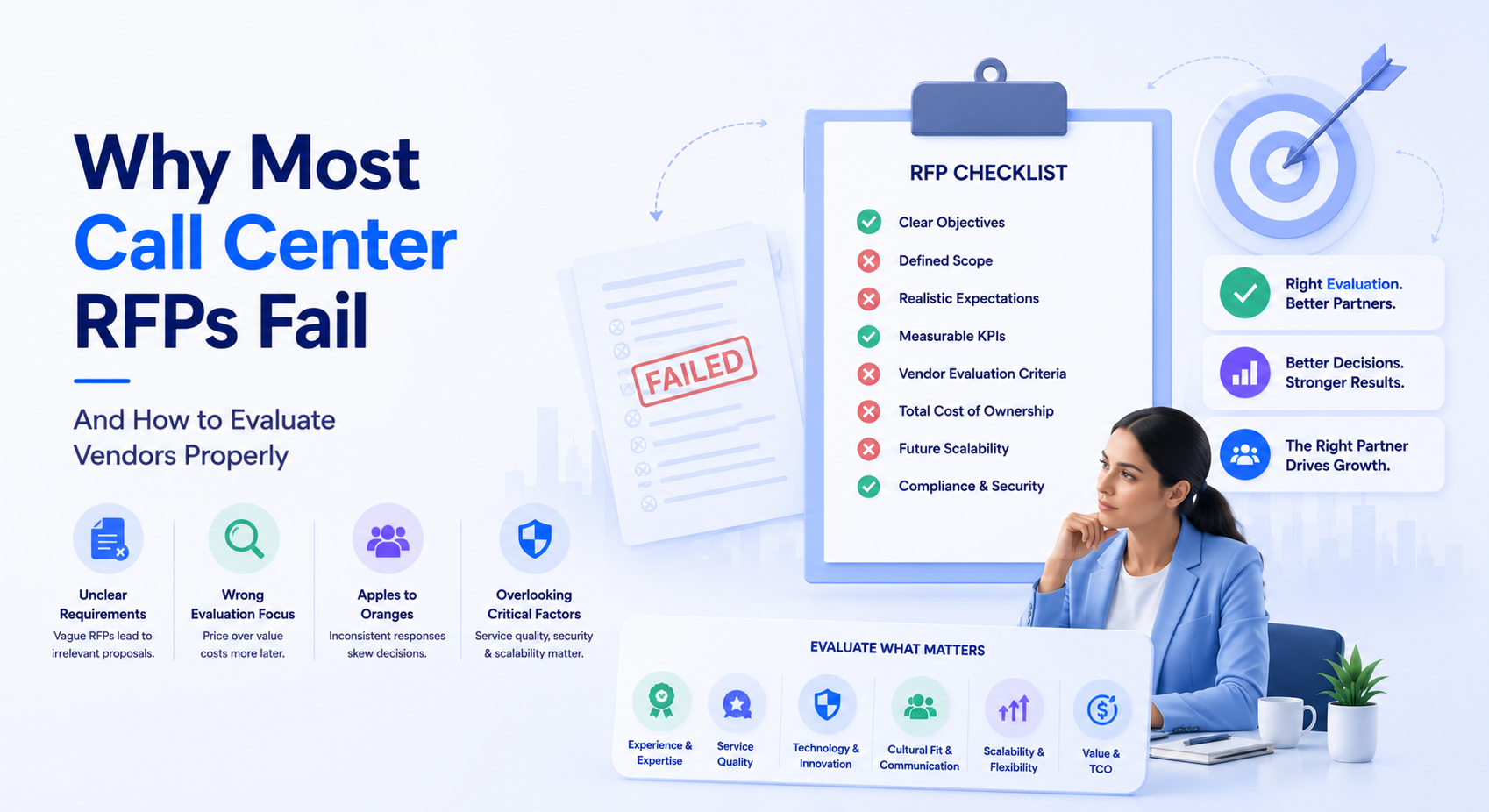
For companies weighing outsourcing in 2026, the state of the industry points to a few clear implications. AI readiness should now be a core selection criterion — a partner that can’t demonstrate real AI capability is behind the market. Flexibility and scalability matter more than ever as businesses favor variable capacity over fixed cost. Compliance and security have become genuine differentiators worth scrutinizing. And the providers delivering the best results are those running true hybrid models — using AI to handle volume while keeping skilled humans on the interactions that need judgment and empathy. Our guide on how to choose a call center outsourcing partner translates these shifts into a practical evaluation framework.
How Octopus Tech Fits the 2026 Landscape
Octopus Tech has delivered outsourced call center and BPO services from India since 2011, spanning voice and non-voice channels and a range of industries. As the industry shifts toward AI-augmented, hybrid delivery, an experienced India-based partner is positioned to combine cost-effective scale with the human expertise that complex interactions still require. If you’re planning your support strategy for the year ahead, get in touch for a no-obligation conversation about your requirements.
Frequently Asked Questions
What is the biggest trend in call center outsourcing in 2026?
Artificial intelligence is the defining trend. Gartner projects conversational AI will reduce contact center agent labor costs by $80 billion in 2026. AI now handles routine queries and assists agents in real time, while human agents focus on complex, higher-value interactions — a restructuring of the work rather than wholesale replacement.
Is AI replacing call center jobs?
Not wholesale. The clearer picture is restructuring: AI automates routine, high-volume work, while human roles shift toward more complex, higher-skilled, higher-value interactions. Gartner projects only about one in ten agent interactions will be automated by 2026, so human agents remain essential — their work just changes.
How big is the call center outsourcing market in 2026?
Industry forecasts place the global call center outsourcing market in the region of $380 billion in 2026, growing at roughly a 9% annual rate in the following years. Notably, outsourced operations are growing faster than in-house centers, and the software and AI segments are expanding faster still.
What are typical call center benchmarks in 2026?
Commonly referenced benchmarks include an average handle time around six minutes, an industry-wide first contact resolution rate of roughly 70%, and agent attrition often cited in the 30–45% annual range. These vary significantly by industry, channel, and work complexity, so they serve as reference points rather than universal targets.
Why does the Gartner $80 billion AI figure matter?
It signals how dramatically AI is reshaping contact center economics. Because labor can represent up to 95% of contact center costs and there are roughly 17 million agents worldwide, even automating one in ten interactions produces tens of billions in cost displacement. It’s become the most-cited statistic in industry conversations about AI investment.
What is a hybrid call center model?
A hybrid model blends AI automation with human agents — using AI to handle routine, high-volume queries and assist agents in real time, while humans handle complex, sensitive, or empathy-driven interactions. Across the industry in 2026, hybrid models are outperforming both pure-automation and pure-human approaches.
How is India’s outsourcing industry positioned in 2026?
India remains a central global outsourcing hub, with a large English-speaking talent pool, mature infrastructure, and a strong cost position. As AI absorbs tier-one volume, Indian providers are increasingly moving into higher-value and AI-adjacent work such as data annotation, analytics, and AI-supported customer operations.
Looking Ahead
The state of call center outsourcing in 2026 is best summarized as transformation, not contraction. AI is reshaping the economics and the workforce, the market continues to grow, and the winners are the providers and buyers embracing flexible, hybrid, AI-augmented models while keeping human expertise where it matters most. For businesses, the strategic priorities are clear: prioritize AI-ready, flexible, secure partners, and treat outsourcing as a way to combine technological efficiency with human judgment rather than choosing between them.
Octopus Tech provides outsourced call center and BPO services from India, combining cost-effective scale with the human expertise that complex customer interactions demand. To discuss how to build a future-ready support operation, get in touch for a no-obligation conversation.