Multilingual Call Center Services: A Complete Guide
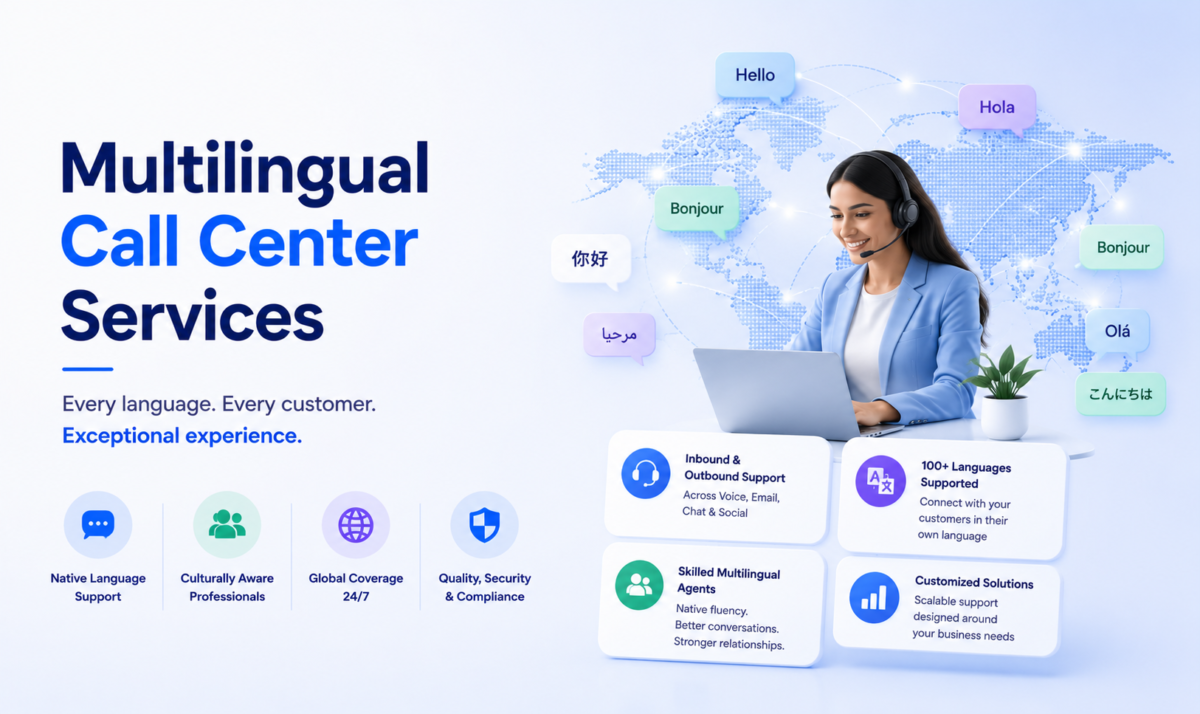
A multilingual call center is a contact center that delivers customer support in multiple languages, so customers can be served in their own language across phone, chat, email, and social channels. It works through three delivery models — dedicated bilingual agents, on-demand interpreters, or AI-powered real-time translation — and most modern operations blend them. For businesses serving global or linguistically diverse markets, multilingual support is no longer optional: research shows the large majority of customers prefer to buy and stay loyal when served in their native language. This guide explains what multilingual call center services are, how they work, the benefits, the languages and channels involved, and how to choose the right provider.
Key Takeaways
- A multilingual call center serves customers in multiple languages across voice and digital channels, unlike a single-language or merely bilingual operation.
- There are three delivery models: dedicated bilingual agents, interpreters (on-demand), and AI real-time translation — most operations use a hybrid of these.
- The business case is strong: CSA Research found 76% of consumers prefer to buy in their native language, and 75% are more likely to repurchase when supported in it.
- Outsourcing multilingual support is usually faster and more cost-effective than recruiting native speakers for every language in-house.
- The right approach matches dedicated agents to your highest-volume languages and interpreters or AI to the long tail.
What Is a Multilingual Call Center?
A multilingual call center is a specialized contact center that provides customer support across multiple languages, ensuring interactions are smooth, effective, and culturally appropriate. Unlike a traditional call center that supports a single language — or a bilingual center limited to two — a multilingual operation employs agents and tools fluent in several languages to serve a diverse, often global, customer base.
Industries with an international or multicultural presence — e-commerce, travel and hospitality, SaaS, telecommunications, and financial services among them — rely on multilingual support to handle inquiries in each customer’s preferred language and deliver consistent quality regardless of language. Importantly, the need isn’t only international: even within a single domestic market, large segments of customers prefer support in a language other than the national default.
Why Multilingual Support Matters: The Business Case
Serving customers in their own language isn’t a courtesy — it directly affects revenue, retention, and trust. The most-cited evidence comes from CSA Research’s “Can’t Read, Won’t Buy” study of 8,709 consumers across 29 countries, which found that 76% of online shoppers prefer to buy products with information in their native language, and 40% will never buy from websites in other languages. The same research found that 75% of customers are more likely to make repeat purchases when customer support is provided in their native language.
The implications for support are direct:
- Revenue and market access. Failing to support a language can mean losing a large share of a potential market. Multilingual support unlocks new regions and customer segments.
- Retention and loyalty. When customers feel understood, they’re less likely to leave for a competitor. Native-language support measurably increases repeat business.
- Trust and brand perception. Serving customers in their language — with cultural awareness, not just literal translation — signals respect and builds trust.
- Fewer errors and escalations. Communicating in the customer’s language reduces miscommunication, repeat contacts, and costly mistakes.
How Multilingual Call Centers Work: The Three Delivery Models
Multilingual support is delivered through three main models, each with different strengths. Understanding them is key to designing the right operation.
- Dedicated bilingual / native-speaker agents. Agents fluent in a specific language handle interactions directly. This delivers the highest quality and cultural fluency, and is the best fit for your highest-volume languages where consistent, brand-aligned support matters most.
- Interpreters (over-the-phone interpretation, or OPI). On-demand interpreters bridge the conversation between an agent and a customer. This is ideal for the “long tail” of lower-volume languages where staffing dedicated agents isn’t practical, giving you broad coverage (often across hundreds of languages) without permanent headcount.
- AI / real-time translation. Technology auto-translates between agent and customer in real time. It’s increasingly capable, scales quickly, and reduces cost, but works best for routine interactions rather than complex or sensitive ones.
The 2026 best practice is a hybrid model: dedicated bilingual teams for your highest-volume languages (often Spanish, French, or Mandarin in Western markets), interpreters or AI for the long tail, and human agents reserved for the interactions where nuance and empathy matter most. Our deeper comparison of in-house agents vs. interpretation vs. AI translation covers how to choose between them.
Languages and Channels
A strong multilingual operation covers both the languages your customers speak and the channels they use. On languages, the practical approach is to prioritize by customer volume: identify your highest-demand languages for dedicated agents, then cover the rest through interpretation or AI. Common high-demand languages for Western-market businesses include Spanish, French, German, Portuguese, Arabic, and Mandarin, though the right set depends entirely on your customer base.
On channels, multilingual support should be omnichannel — phone, live chat, email, and social media — with a unified customer view so language and context follow the customer across touchpoints. Consistency across both languages and channels is critical: when your support gives different answers in different languages, it erodes trust, so unified processes and knowledge bases matter as much as the agents themselves.
In-House vs. Outsourced Multilingual Support
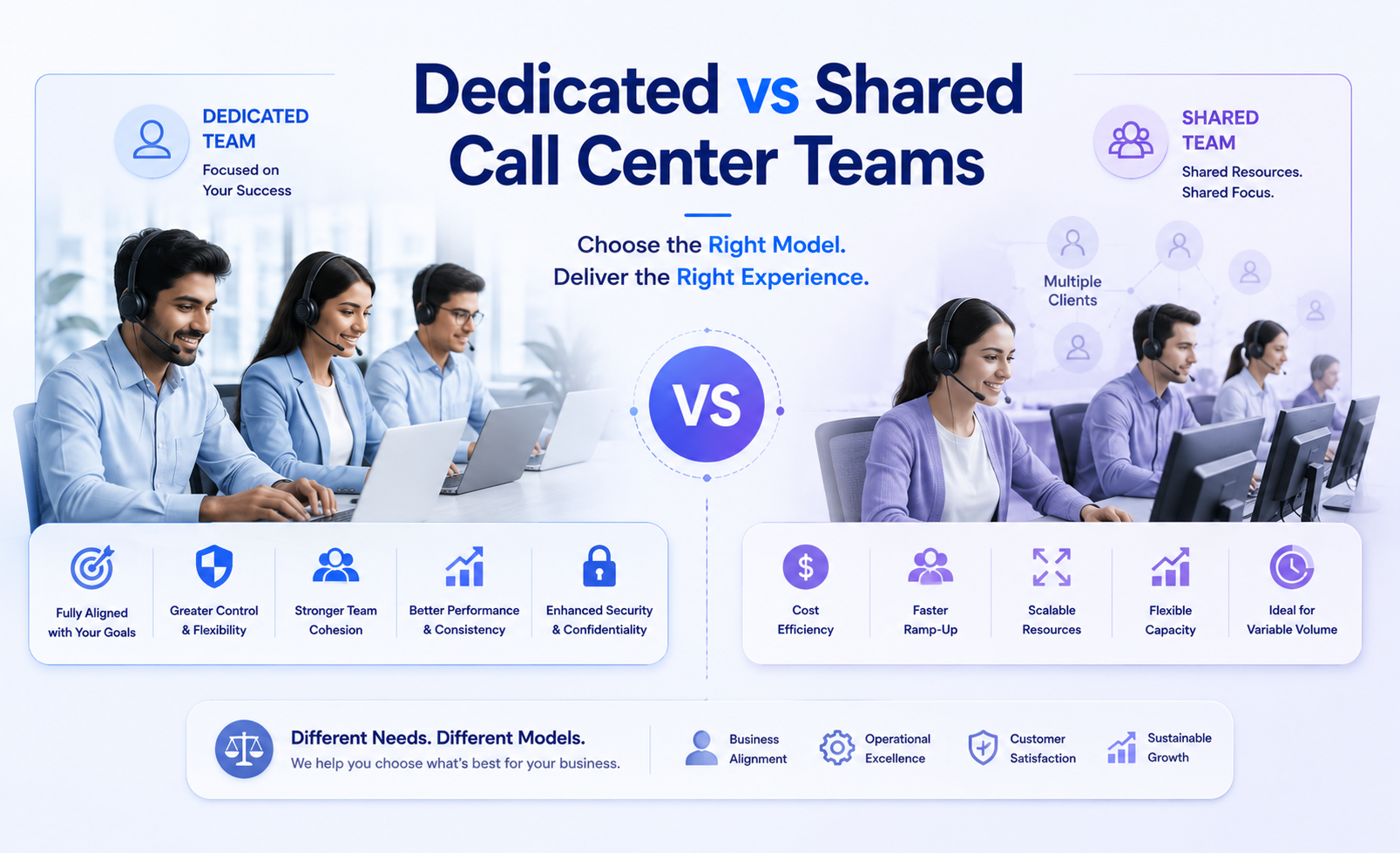
Businesses can build multilingual support in-house or outsource it, and the trade-off usually favors outsourcing once more than one or two languages are involved. Recruiting, training, and retaining native speakers across many languages is slow and expensive, and demand for each language fluctuates. An outsourcing partner already has multilingual talent, interpretation access, and the technology in place, converting fixed staffing costs into flexible, scalable capacity — letting you add languages quickly without extensive hiring. In-house offers maximum control and is sometimes preferred for a single strategic language; outsourcing wins on speed, breadth, and cost for genuine multilingual coverage. For the broader build-versus-buy analysis, see our in-house vs outsourced call center comparison.
How to Choose a Multilingual Call Center Provider
The right partner for multilingual support should offer:
- Genuine language coverage matched to your customers. Confirm the provider can actually staff your priority languages with fluent, ideally native-level, agents — not just claim broad coverage.
- Cultural fluency, not just translation. The best support adapts tone and communication style to each culture, which requires more than literal language ability.
- A flexible model. The ability to combine dedicated agents, interpretation, and AI so you can match each language to the most cost-effective approach.
- Omnichannel and 24/7 capability. Coverage across channels and time zones, since multilingual customers are often spread across regions.
- Consistent quality across languages. Unified knowledge bases, QA across every language, and processes that ensure customers get the same answers regardless of language.
- Scalability. The ability to add languages and capacity as you enter new markets.
For a complete evaluation framework, see our guide on how to choose a call center outsourcing partner, and our piece on why your business needs multilingual call center services for more on the underlying case.
Why India Is a Strong Base for Multilingual Support
India is a natural hub for multilingual outsourcing. It combines a vast, English-speaking, university-educated workforce with cost efficiency and mature delivery infrastructure, and it offers access to talent across many languages. As AI-assisted translation matures, India-based providers are increasingly able to extend coverage further while keeping skilled human agents on the interactions that need them — pairing broad language reach with cost-effective scale and 24/7 capability.
How Octopus Tech Delivers Multilingual Support
Octopus Tech has provided outsourced call center and BPO services from India since 2011, with multilingual and multichannel capability across voice and non-voice support. With round-the-clock coverage and experience across industries like e-commerce, travel, fintech, and telecom, Octopus Tech is positioned to help businesses serve diverse, global customer bases in the languages their customers prefer. If you’re planning multilingual support, get in touch for a no-obligation conversation about which languages and channels your operation needs.
Frequently Asked Questions
What is a multilingual call center?
A multilingual call center is a contact center that provides customer support in multiple languages across channels like phone, chat, and email. Unlike a single-language or bilingual center, it uses agents and tools fluent in several languages to serve a diverse or global customer base with culturally appropriate service.
How do multilingual call centers work?
They operate through three delivery models: dedicated bilingual or native-speaker agents who handle interactions directly, on-demand interpreters (over-the-phone interpretation) for lower-volume languages, and AI-powered real-time translation. Most modern operations use a hybrid — dedicated agents for high-volume languages and interpreters or AI for the long tail.
Why is multilingual customer support important?
Because language strongly influences buying and loyalty. CSA Research found that 76% of consumers prefer to buy in their native language and 75% are more likely to repurchase when supported in it. Multilingual support unlocks new markets, improves retention, builds trust, and reduces miscommunication and escalations.
Should I build multilingual support in-house or outsource it?
Outsourcing usually wins once more than one or two languages are involved, because recruiting and retaining native speakers across many languages in-house is slow and costly. An outsourcing partner provides existing multilingual talent, interpretation, and technology as flexible, scalable capacity. In-house offers more control and can suit a single strategic language.
Which languages should a multilingual call center support?
Prioritize by customer volume: staff dedicated agents for your highest-demand languages and cover the rest through interpretation or AI. Common high-demand languages for Western-market businesses include Spanish, French, German, Portuguese, Arabic, and Mandarin, but the right set depends entirely on your specific customer base.
What is the difference between bilingual and multilingual call centers?
A bilingual call center supports two languages (commonly English plus one other), while a multilingual call center supports several languages and is specifically designed to serve a diverse, multi-language customer base across many regions. Multilingual operations typically combine dedicated agents, interpreters, and translation technology to achieve that breadth.
How does outsourcing multilingual support to India work?
India-based providers deliver multilingual support by combining a large, English-speaking workforce, access to multilingual talent, interpretation services, and increasingly AI translation, all at competitive cost. This lets businesses serve customers in multiple languages with 24/7 coverage while keeping costs lower than building equivalent in-house teams.
Serving Every Customer in Their Language
Multilingual call center services let businesses meet customers where they are — in their own language, across every channel — which the evidence shows directly drives purchases, loyalty, and trust. The most effective operations blend dedicated bilingual agents for high-volume languages with interpretation and AI for the rest, delivered consistently across channels and backed by genuine cultural fluency. Done well, multilingual support turns language from a barrier into a competitive advantage.
Octopus Tech provides outsourced multilingual, multichannel call center services from India, built to help businesses serve global and diverse customer bases. To discuss the languages and coverage your operation needs, get in touch for a no-obligation conversation.