How to Choose a Reliable Data Annotation Partner for AI Models
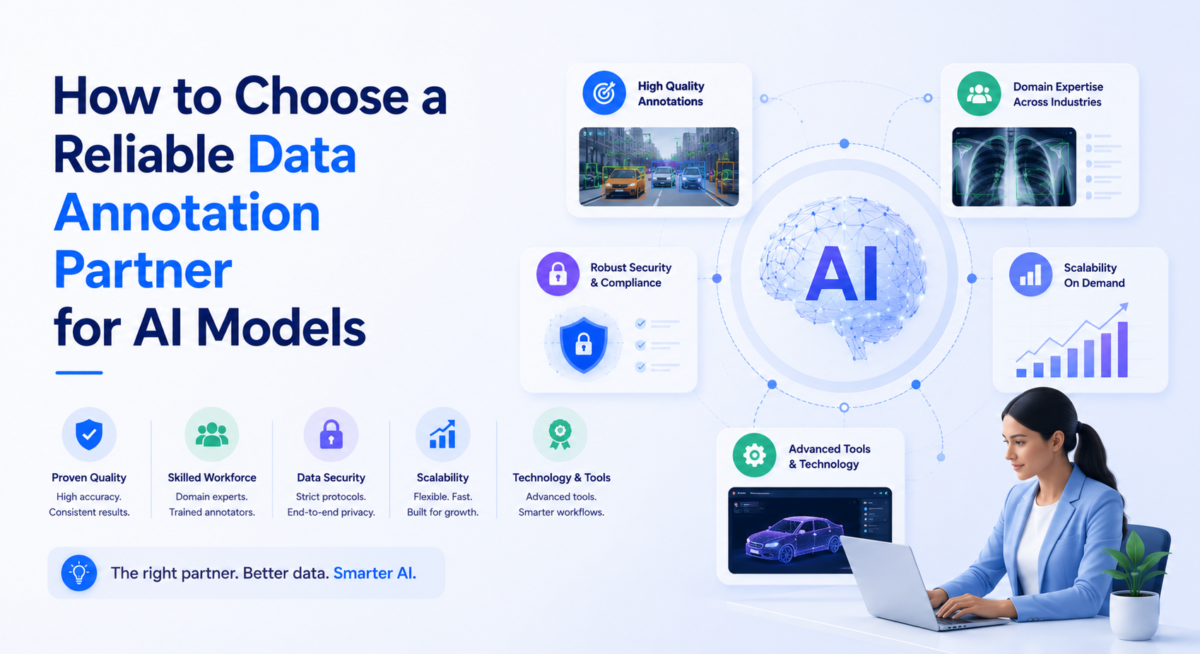
Choosing a reliable data annotation partner comes down to seven things: proven annotation quality, domain expertise in your use case, the right mix of human and AI-assisted labeling, strong data security and compliance, the ability to scale, transparent pricing, and clear communication. The right partner doesn’t just label data; they engineer the high-quality training data your models depend on, because in machine learning the data matters more than the algorithm. This guide walks through exactly what to evaluate, the warning signs to avoid, and the questions to ask before you sign, so you can pick a partner that improves model accuracy rather than quietly degrading it.
Key Takeaways
- Data quality, not model architecture, drives most of an AI model’s real-world performance, so your annotation partner directly shapes your results.
- The most important criteria are annotation accuracy, domain expertise, security and compliance, scalability, and a transparent quality-assurance process.
- Ask for measurable quality metrics: inter-annotator agreement, accuracy rates, and a documented multi-layer review process.
- A strong partner blends skilled human annotators with AI-assisted tooling, keeping humans in the loop for complex or sensitive data.
- Watch for red flags like vague quality claims, no security certifications, hidden costs, and an inability to handle your data type or volume.
Why Your Data Annotation Partner Decides Your Model’s Success
Before comparing vendors, it helps to understand why this decision carries so much weight. AI models learn from the data they’re trained on, so the quality of that labeled data sets the ceiling on how well the model can ever perform. Poorly labeled data teaches a model the wrong patterns, and no amount of clever engineering fully recovers from that.
The industry has increasingly recognized this. AI pioneer Andrew Ng has championed a “data-centric” approach to AI, arguing that systematically improving data quality matters more than endlessly tweaking models, and noting that data preparation accounts for roughly 80% of the work in a typical machine learning project. Market research echoes the point: one analysis found that over 70% of model performance improvements are attributed to data quality rather than architectural changes. In short, your annotation partner isn’t a back-office vendor; they’re a direct input into how accurate, fair, and reliable your model becomes.
This also explains why demand is surging. The data annotation tools market is projected to grow from about $2.32 billion in 2025 to $3.07 billion in 2026, driven by enterprises that now treat labeling as core AI infrastructure rather than a cost to minimize. With more providers entering the space, knowing how to separate a reliable partner from a risky one matters more than ever.
1. Proven Annotation Quality and a Real QA Process
Quality is the single most important criterion, and the only one that’s hard to fake if you ask the right questions. Any provider can claim “high accuracy”; a reliable one can show you how they measure and maintain it.
Look for a documented, multi-layer quality-assurance process: initial annotation, independent review, and a final validation or spot-check stage. Ask how they measure quality in numbers. Two metrics matter most. Accuracy rate is the share of labels that are correct against a ground-truth standard, and the best large-scale projects aim to hold this above 98%. Inter-annotator agreement measures how consistently different annotators label the same item; for complex tasks, agreement rates commonly range between 80% and 90%, so a partner who tracks and works to improve this number is taking consistency seriously.
Consistency is genuinely hard at scale. Industry surveys show that 55% of organizations struggle to manage quality and consistency across large annotated datasets. A capable partner addresses this with clear labeling guidelines, annotator training, cross-validation, and a feedback loop that updates instructions whenever disagreements surface. If a provider can’t explain their QA workflow in concrete terms, treat that as a warning sign.
2. Domain Expertise in Your Specific Use Case
Labeling a street scene for an autonomous vehicle, a chest X-ray for a diagnostic model, and a customer chat for sentiment analysis demand completely different knowledge. Generic annotation skills aren’t enough when the data is specialized; an annotator who doesn’t understand the domain will produce labels that look fine but are subtly wrong.
This is especially true in regulated or high-stakes fields like healthcare, finance, and legal, where a mislabel can carry real consequences. The talent gap here is significant: research indicates the industry needs roughly 45% more trained annotators than are currently available, with the shortage most acute in domains that require specialized knowledge. When evaluating a partner, ask for experience with your exact data type and industry, request relevant case studies, and consider a paid pilot on a sample of your real data before committing to volume.
3. The Right Balance of Human Annotators and AI-Assisted Tooling
Modern annotation isn’t purely manual or purely automated; the strongest providers combine both. AI-assisted tools can pre-label data, flag likely errors, and speed up repetitive work, which lowers cost and turnaround time. But automation alone tends to replicate its own mistakes, so skilled human reviewers remain essential, particularly for ambiguous, complex, or sensitive data.
This “human-in-the-loop” model is now the established best practice. Ask a prospective partner how they divide work between automation and people, where humans review machine output, and how they prevent automated tools from amplifying bias. A reliable partner uses AI to make their annotators faster and more consistent, not to quietly replace the human judgment your model depends on. For a deeper look at why this foundation matters, our piece on why high-quality data annotation is the backbone of AI success explains the link between labeling quality and model outcomes.
4. Data Security, Privacy, and Compliance
Annotation work often involves sensitive data: medical records, financial information, personal images, or proprietary business data. A breach or compliance failure on your partner’s side becomes your liability, so security is non-negotiable.
Check for recognized information-security practices and certifications such as ISO 27001, and for compliance with the regulations that apply to your data, like GDPR for personal data or HIPAA for health information. Beyond certificates, ask practical questions: How is data encrypted in transit and at rest? Who can access it, and how is that access logged? Are annotators bound by confidentiality agreements? Can they support secure facilities or restricted environments for the most sensitive projects? Regulatory pressure for auditable, transparent data handling is rising across the industry, and a serious partner will already have clear answers rather than scrambling to assemble them.
5. Scalability and Turnaround Time
Your annotation needs will rarely be static. A pilot might require a few thousand labeled items; a production model can need millions, often on a deadline. A reliable partner can scale capacity up or down without sacrificing quality, and can give you realistic, consistent turnaround times rather than promises they can’t keep.
Ask how large their annotator workforce is, how quickly they can ramp up for a surge, and how they maintain quality when a project grows. The talent shortage makes this harder than it sounds: more than half of providers report difficulty finding specialists, with one survey finding that 52% of market players face talent shortages for specialized annotation tasks. A partner with a deep, trained workforce and the infrastructure to manage it is far better positioned to grow with you, which is one reason many AI teams look to established outsourcing hubs with large talent pools.
6. Transparent Pricing and Clear Value
Price matters, but the cheapest quote is rarely the best value in annotation, where low rates often signal rushed work, weak QA, or inexperienced labelers, all of which cost far more to fix downstream. The goal is transparent pricing tied to a clear quality standard, not the lowest headline number.
Understand exactly what a quote includes. Is QA and rework built in, or billed separately? Is pricing per item, per hour, or per project, and which model fits your volume pattern? Are there setup, tooling, or minimum-volume fees? Sophisticated in-house annotation platforms can cost over $100,000 annually, which is part of why many organizations outsource to a specialist partner instead of building the capability from scratch. Evaluate partners on total cost to reach your required accuracy, not on the raw per-label rate.
7. Communication, Project Management, and Cultural Fit
Annotation is collaborative. Your guidelines will evolve, edge cases will emerge, and you’ll need a partner who flags ambiguities early rather than guessing and mislabeling thousands of items. Strong communication and project management often separate a smooth engagement from a frustrating one.
Look for a dedicated point of contact, regular progress reporting, and a clear process for handling questions and revising guidelines. Time-zone overlap and responsiveness matter for real-time collaboration. These are the same partner-evaluation principles that apply across outsourcing generally; our guide on how to choose an outsourcing partner covers the communication and management questions worth asking any provider.
Red Flags to Watch For
Alongside the positive criteria, a few warning signs should give you pause:
- Vague quality claims. A partner who can’t give you concrete accuracy metrics or describe their QA process likely doesn’t have a strong one.
- No security certifications or clear data-handling policy. This is a serious risk with sensitive data and shouldn’t be negotiable.
- Unwillingness to run a pilot. A confident partner will happily prove quality on a sample of your real data first.
- Hidden or unclear pricing. If you can’t tell what’s included, assume rework and QA aren’t.
- No domain experience. For specialized data, a generalist provider with no relevant track record is a gamble.
- Over-reliance on full automation. Pure machine labeling with no meaningful human review tends to scale errors, not quality.
Why Many AI Teams Choose Data Annotation Partners in India
India has become a leading destination for data annotation for the same reasons it leads in broader outsourcing: a vast, educated, English-speaking workforce, strong cost efficiency, and decades of mature delivery infrastructure. For annotation specifically, the depth of available talent is a real advantage given the industry-wide shortage of trained annotators, and the cost structure lets AI teams label large volumes without the six-figure overhead of building an in-house operation.
As with any location, the key is choosing a provider whose quality systems and security practices genuinely hold up, not simply the cheapest seat. For the broader picture, see our overview of the pros and cons of outsourcing to India, and if you’re comparing specific vendors, our roundup of the top data annotation companies in India is a useful starting point. Our companion guide on how to choose the right data annotation service provider covers complementary factors in more depth.
How Octopus Tech Approaches Data Annotation
Octopus Tech provides data annotation services from India as part of its broader BPO services delivered since 2011, combining trained human annotators with quality-control processes designed to keep accuracy high across large, complex datasets. Pairing skilled people with structured review and clear communication is what allows an annotation partner to deliver training data that actually improves model performance rather than undermining it. If you’re evaluating partners for an AI project, get in touch to discuss your data type, volume, and quality requirements.
Frequently Asked Questions
What is a data annotation partner?
A data annotation partner is a specialized provider that labels, tags, and structures raw data, such as images, text, audio, or video, so it can be used to train and validate AI and machine learning models. A reliable partner combines skilled annotators, quality-assurance processes, and secure data handling to produce accurate, consistent training data at scale.
Why is data annotation quality so important for AI models?
Because models learn from labeled data, the quality of that data sets the ceiling on model performance. Poorly labeled data teaches the wrong patterns and degrades accuracy. Industry research attributes the majority of real-world model performance gains to data quality rather than model architecture, which is why the choice of annotation partner directly affects your results.
What should I look for when choosing a data annotation provider?
Focus on seven things: proven annotation accuracy and a documented QA process, domain expertise in your use case, a sensible mix of human and AI-assisted labeling, strong data security and compliance, the ability to scale with reliable turnaround times, transparent pricing tied to a quality standard, and clear communication and project management.
How do I measure the quality of a data annotation service?
Ask for concrete metrics. Accuracy rate measures the share of correct labels against a ground truth, with leading projects aiming above 98%. Inter-annotator agreement measures how consistently different annotators label the same item. Also confirm there’s a multi-layer review process, clear labeling guidelines, and a feedback loop that resolves disagreements.
Should I outsource data annotation or build an in-house team?
Outsourcing usually wins for cost, speed, and access to trained annotators, especially given the industry-wide talent shortage and the high cost of annotation tooling and infrastructure. Building in-house offers maximum control and can suit highly sensitive or proprietary projects, but it’s slower and more expensive to scale across data types and volumes.
Why is India a popular choice for data annotation outsourcing?
India offers a large, educated, English-speaking workforce, strong cost efficiency, and mature delivery infrastructure, which together address the trained-annotator shortage while keeping costs manageable. The important step is verifying that a specific provider has genuine quality systems, domain experience, and security practices rather than choosing on price alone.
How important is data security in data annotation?
It’s critical, because annotation often involves sensitive medical, financial, or personal data, and a breach on the partner’s side becomes your liability. Look for recognized certifications such as ISO 27001, compliance with relevant regulations like GDPR or HIPAA, encryption in transit and at rest, access controls, and confidentiality agreements with annotators.
Choosing Your Annotation Partner With Confidence
Selecting a data annotation partner is ultimately a decision about the quality of your AI itself. Because labeled data does more to shape model performance than the model design, the partner you choose has an outsized effect on whether your AI works in the real world. Weigh proven quality, domain expertise, the right human-and-AI balance, security, scalability, transparent pricing, and communication, and treat any vendor who can’t speak clearly to these as a risk. Run a pilot, ask for the numbers, and choose the partner who treats your data as the foundation it actually is.
Octopus Tech provides outsourced data annotation and BPO services from India, built around the quality and security that AI projects demand. To discuss your annotation requirements, get in touch for a no-obligation conversation.