Why Most Call Center RFPs Fail (And How to Evaluate Vendors Properly)
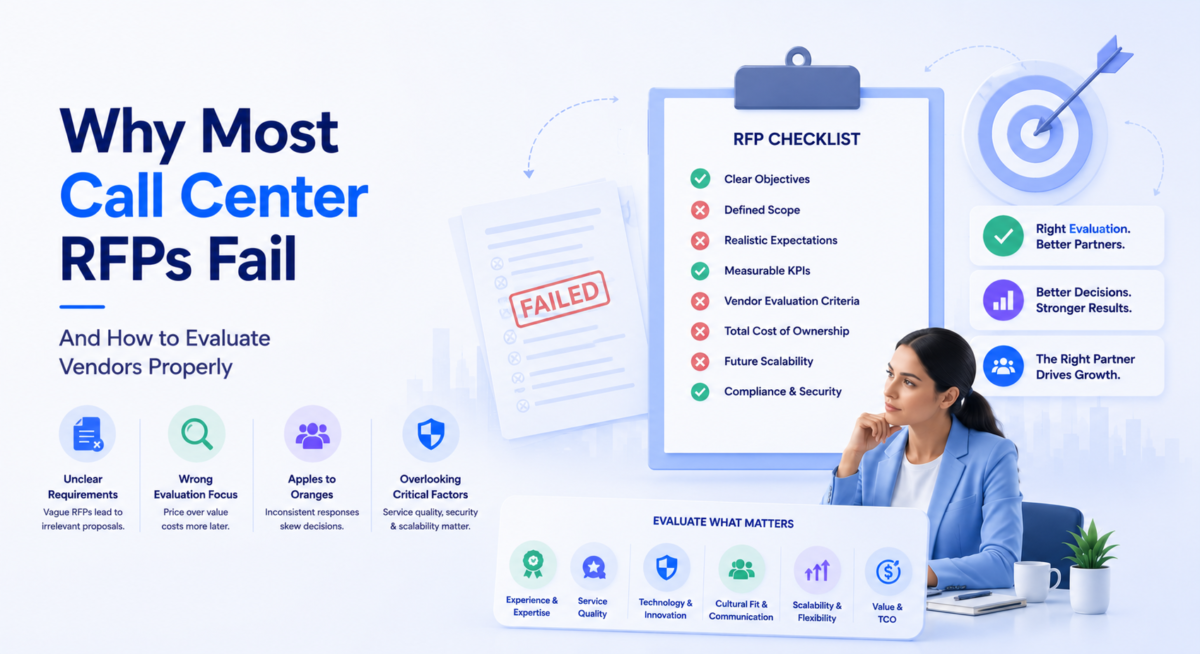
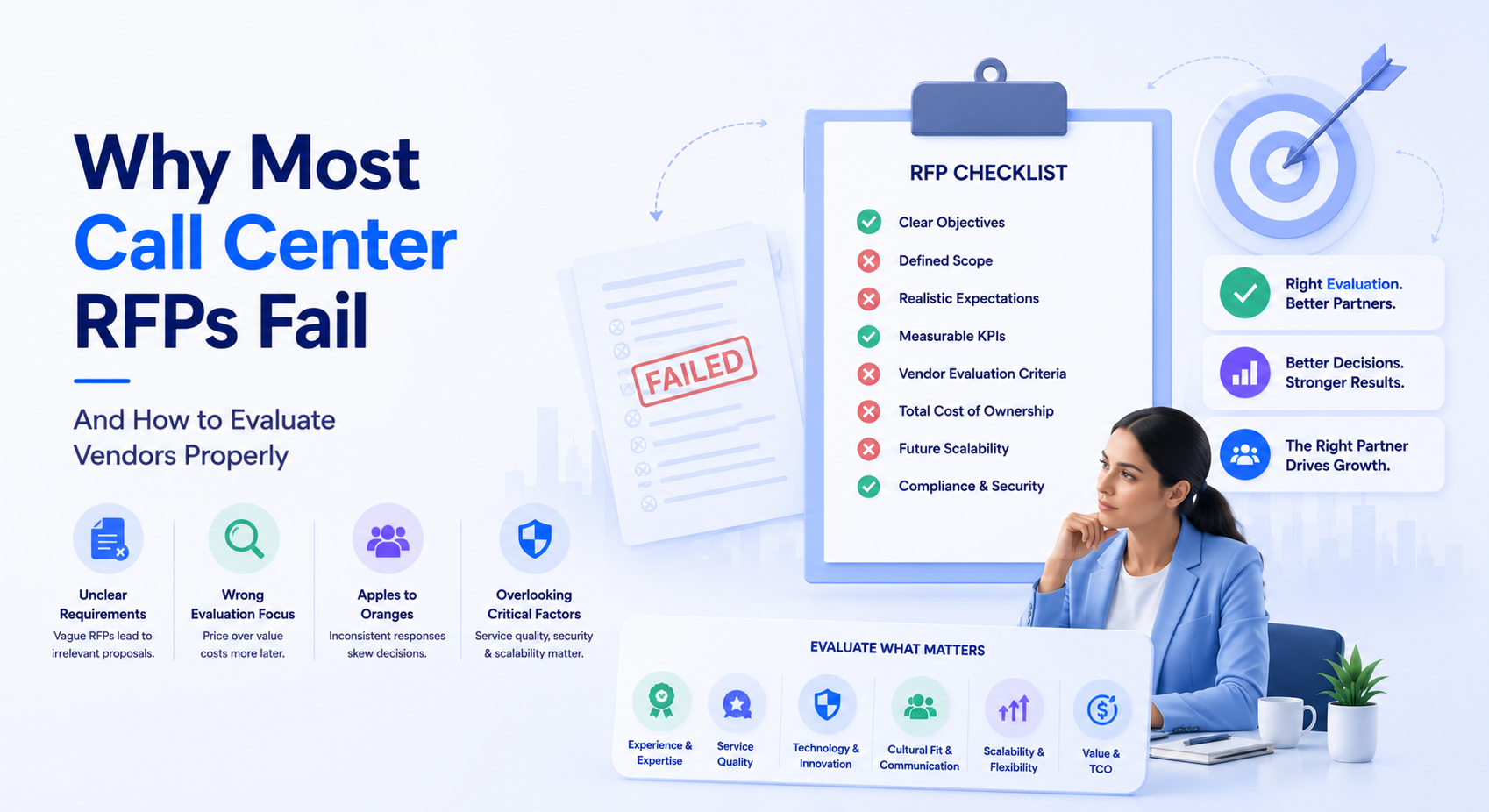
Most call center RFPs fail for a simple reason: they’re built to collect proposals, not to identify the right partner. Buyers blast a generic document to a long, unvetted list of vendors, skim straight to the pricing page, and pick on cost, which is exactly how outsourcing relationships go wrong. The RFP itself isn’t the problem; the way it’s used is. This guide explains the specific reasons call center RFPs break down, backed by industry data, and lays out a better way to evaluate vendors, one focused on fit, capability, and proof rather than paperwork and price.
Key Takeaways
- RFPs usually fail in how they’re run, not in concept: unvetted vendor lists, vague requirements, and price-first decisions.
- The process is widely disliked on both sides. Industry surveys show 60% of clients would prefer to avoid RFPs and 78% are open to alternatives.
- Most failures trace back to weak evaluation, not bad vendors. Deloitte research links a large share of outsourcing failures to implementation and governance, not the choice itself.
- The fix is to pre-qualify a short list, define requirements precisely, score against a weighted scorecard, and validate proof through references and pilots.
- Evaluate on total value and cultural fit, never the lowest headline price, which is the single most common selection mistake.
What a Call Center RFP Is Supposed to Do
A Request for Proposal is meant to be a structured way to compare vendors against your real requirements. Done well, it forces you to define your scope, service levels, staffing model, and integration needs before you talk to providers, and it gives every shortlisted vendor a fair, like-for-like opportunity to show how they’d deliver.
The catch is that the quality of your RFP determines the quality of the responses you get back. A precise, well-structured RFP produces precise, comparable proposals. A vague one produces guesswork and boilerplate. The problem is that most RFPs fall into the second category, and the failures that follow are predictable.
Reason 1: The “Blind RFP” Sent to an Unvetted List
The most common failure happens before a single proposal comes back. Many buyers compile a vendor list with little or no pre-qualification, sometimes literally from a quick search, and email the RFP to everyone at once. This is the “blind RFP,” and it sabotages the process from the start.
Padding the list with random vendors doesn’t improve your odds; it lowers them, because it buries the genuinely qualified providers in noise and produces a stack of incomparable responses. It also drives away the best vendors. In a CustomerServ survey of call center clients and vendors, half of vendors said they won’t respond to an RFP if they have no relationship with the client, and many strong providers quietly decline blind requests because the odds don’t justify the considerable time a quality response takes. The result: you hear from vendors who mass-respond to everything, not the ones who would have been the best fit.
The fix is to treat the vendor list like a hiring shortlist. You wouldn’t interview every résumé you received; you’d screen first. Pre-qualify three to five vendors who genuinely match your scope, geography, and industry, and only send the RFP to those. Our checklist for choosing a call center outsourcing partner covers the screening criteria worth applying before anyone gets an RFP.
Reason 2: Vague Requirements Produce Vague (and Mispriced) Proposals
An RFP that doesn’t clearly define scope, volume, service levels, and technical needs forces vendors to fill the gaps with assumptions. Those assumptions lead to inaccurate pricing and proposals you can’t fairly compare, because each vendor guessed differently about what you actually want.
Precision pays off directly. According to research cited in industry guidance, organizations that include detailed technical specifications and performance expectations in their RFPs are 40% more likely to select a vendor that meets their needs and avoid unexpected costs during implementation. To get there, your RFP should spell out expected contact volumes and patterns, the channels involved (voice, chat, email, social), target service levels and how they’ll be measured, required integrations, reporting expectations, and your security and compliance requirements. Defining service levels carefully matters most, since they become the backbone of the contract; our explainer on SLAs in call centers covers what to specify and how.
Reason 3: Jumping Straight to the Pricing Page
Perhaps the most damaging habit is treating the RFP as a price-discovery exercise. The CustomerServ survey found that almost a third of clients admit they don’t read responses cover to cover, and most vendors suspect buyers skip straight to the pricing page. When price leads the decision, quality, capability, and fit get ignored, and that’s how buyers end up with the cheapest vendor rather than the right one.
This is the classic outsourcing trap. Vendors bid low to win, and the client only discovers the gaps, in task maturity, technology, language capability, or quality, after the contract starts and significant time and money are already committed. The cheapest seat is rarely the cheapest outcome once rework, attrition, and customer dissatisfaction are counted. Price belongs in the evaluation, but as one weighted factor among many, measured as total cost of ownership and cost per resolved contact rather than a raw hourly rate. Our breakdown of the real cost of outsourcing call center services explains how to compare pricing on a true like-for-like basis.
Reason 4: Confusing Vendor Selection With Relationship Success
Even a well-run RFP only gets you to a signature. A striking amount of outsourcing failure happens after selection, during implementation and ongoing management, which means an RFP that ignores those phases is set up to disappoint. Deloitte’s Global Outsourcing Survey has repeatedly found that implementation and governance issues, not the original vendor choice, drive a large share of relationship breakdowns, with roughly a third of failed deals citing misaligned expectations and poor project governance as the cause. Separately, Dun & Bradstreet research has found that about a quarter of outsourcing relationships fail within two years.
The lesson is that your RFP and evaluation should probe how a vendor will run the relationship, not just whether they can win the bid. Ask about their implementation roadmap, transition plan, governance model, reporting cadence, and how they maintain service levels during onboarding. A vendor who can describe exactly how the first 90 days will go is telling you something more valuable than their price.
Reason 5: Boilerplate In, Boilerplate Out
When RFPs are generic, responses are generic. The same CustomerServ survey found that 54% of clients say most RFP responses they receive are cut-and-paste jobs, and many contain errors and sales fluff. But this is partly self-inflicted: vendors copy and paste because each RFP they receive is itself a derivative of another RFP, mechanical and impersonal, giving them no room to show how they’d actually solve your specific problem.
Breaking the cycle means writing an RFP that invites a tailored answer. Include a few scenario-based questions tied to your real situation, “walk us through how you’d handle a seasonal volume spike of X%,” or “describe your approach to a multilingual queue with these languages”, so that copy-paste answers stand out immediately and genuine capability rises to the top.
How to Evaluate Call Center Vendors Properly
Fixing the RFP is really about replacing a paperwork exercise with a disciplined evaluation. Here’s the framework that works:
- Pre-qualify before you send. Screen vendors against scope, industry experience, geography, and capacity first. Send the RFP only to a short list of three to five who can each realistically win.
- Define requirements precisely. Specify volumes, channels, service levels, integrations, reporting, and compliance needs so proposals are comparable and accurately priced.
- Score against a weighted scorecard. Decide your criteria and their weights before responses arrive, then score each vendor objectively. Quality, fit, security, and governance should outweigh price.
- Validate the proof, don’t take claims at face value. Interview current and past clients, check references in your industry, and review real performance data. Past performance predicts future performance better than any proposal narrative.
- Run a paid pilot. A small live pilot reveals more about quality, communication, and culture than any document. Strong vendors welcome it.
- Assess cultural and communication fit. Your vendor represents your brand to your customers. Responsiveness, time-zone overlap, and shared standards matter as much as the spec sheet.
For the full set of evaluation criteria to build into your scorecard, see our guide on how to choose the right call center services provider.
When the RFP Isn’t the Right Tool at All
Sometimes the honest answer is that a traditional RFP is the wrong instrument. It’s a heavy, resource-intensive process, and the survey data reflects the fatigue: 60% of clients say they’d prefer to avoid RFPs altogether, and 78% are open to alternatives. For smaller engagements, urgent needs, or when you already have a strong relationship with a capable provider, a leaner path, an RFI to narrow the field, structured discovery calls, reference checks, and a pilot, can identify the right partner faster and with less friction.
The deeper decisions often sit underneath the RFP anyway: whether to keep support in-house or outsource it, and where to base it. Those are worth settling first. Our comparison of in-house versus outsourced call center models and our guide to nearshore, offshore, and onshore delivery help you frame those choices before you ever write a requirements document.
How Octopus Tech Approaches Vendor Evaluation
Octopus Tech has delivered outsourced call center services from India since 2011, and we’ve responded to enough RFPs to know that the best engagements start with a clear, honest conversation about scope, service levels, and fit, not a thick document and a race to the lowest price. We’d rather show you how we’d handle your specific volumes and channels, share relevant references, and run a pilot than send boilerplate. If you’re evaluating partners for a call center project, get in touch to discuss your requirements directly.
Frequently Asked Questions
Why do most call center RFPs fail?
Most fail because of how they’re run, not the concept itself. Common causes include sending a generic RFP to a long, unvetted vendor list, writing vague requirements that produce mispriced and incomparable proposals, deciding on price alone, and ignoring implementation and governance, where much outsourcing failure actually occurs.
What is a “blind RFP”?
A blind RFP is one sent to vendors without any pre-qualification, often to a long list compiled with little screening. It backfires because it produces incomparable responses and drives away strong vendors. Surveys show many providers won’t respond to an RFP from a client they have no relationship with, so you lose the best candidates.
How should I evaluate call center outsourcing vendors?
Pre-qualify a short list of three to five vendors, define your requirements precisely, and score proposals against a weighted scorecard set before responses arrive. Then validate claims through client references and past-performance data, run a paid pilot, and assess cultural and communication fit. Weight quality, security, and governance above price.
Should price be the main factor in choosing a call center vendor?
No. Choosing on lowest price is the most common and costly selection mistake, because cheap bids often hide gaps in quality, technology, or capability that surface only after the contract starts. Evaluate price as one weighted factor, measured as total cost of ownership and cost per resolved contact rather than a raw hourly rate.
Is an RFP always necessary to choose a call center partner?
Not always. RFPs suit large, complex, or procurement-mandated engagements, but they’re resource-intensive, and most buyers say they’d prefer alternatives. For smaller or urgent needs, a leaner process, an RFI, structured discovery calls, reference checks, and a pilot, can identify the right partner with far less friction.
How do I write requirements that get good proposals?
Be specific. State your contact volumes and patterns, channels, target service levels and how they’re measured, required integrations, reporting needs, and compliance requirements. Add a few scenario-based questions tied to your real situation so vendors must give tailored answers rather than copy-and-paste boilerplate.
What causes outsourcing relationships to fail after the contract is signed?
Research points to implementation and governance rather than the initial vendor choice. Deloitte’s Global Outsourcing Survey links a large share of failures to misaligned expectations and poor project governance, and other research finds about a quarter of relationships fail within two years. That’s why your evaluation should probe transition plans, governance, and reporting, not just the bid.
Choose a Partner, Not Just a Proposal
The RFP isn’t broken, but the way most companies use it is. When you blast a vague document to an unscreened list and decide on price, you almost guarantee a poor match. When you pre-qualify a short list, define requirements precisely, score against a thoughtful scorecard, and validate with references and a pilot, you turn the same process into a genuine partner-selection tool. The goal was never to collect the most proposals; it’s to find the one provider who will actually deliver for your customers.
Octopus Tech provides outsourced call center and BPO services from India, built around fit, quality, and transparency rather than the lowest bid. To discuss your requirements and how we’d approach them, get in touch for a no-obligation conversation.