What Is Average Handle Time (AHT) and How to Reduce It?
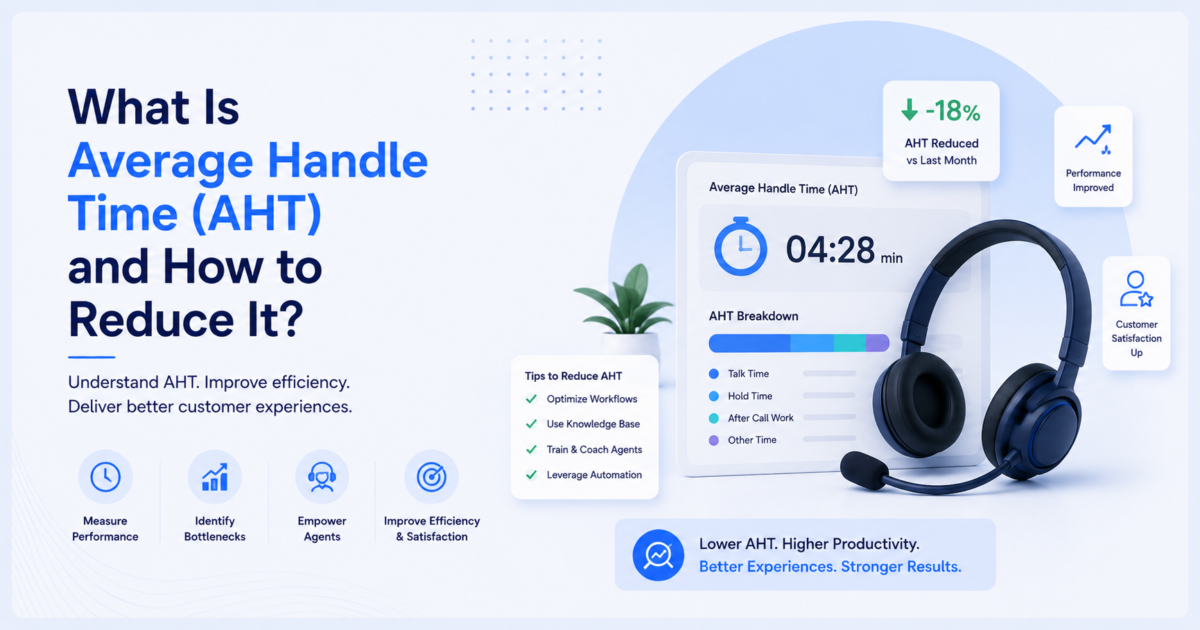
Average Handle Time (AHT) is a call center metric that measures the average duration of a complete customer interaction — from the moment an agent connects with the customer to the end of any follow-up work. It is calculated with a simple formula: AHT = (Total Talk Time + Total Hold Time + Total After-Call Work) ÷ Total Number of Calls. AHT is one of the most important efficiency metrics in any contact center because it directly affects staffing, cost per contact, and customer experience. But lower is not automatically better: cutting AHT too aggressively can hurt resolution quality. This guide explains exactly what AHT is, how to calculate it, what a good benchmark looks like, and proven ways to reduce it without sacrificing quality.
Key Takeaways
- AHT measures the average length of a full customer interaction, including talk time, hold time, and after-call work (ACW).
- The formula is: AHT = (Total Talk Time + Total Hold Time + Total After-Call Work) ÷ Total Number of Calls.
- A commonly cited industry benchmark is around 6 minutes, but “good” AHT varies widely by industry and issue complexity.
- AHT should never be optimized in isolation — pair it with First Call Resolution (FCR) and CSAT, or you risk rushing customers and lowering satisfaction.
- The biggest, safest AHT reductions come from better agent tools, knowledge bases, training, smart routing, and reducing after-call work.
What Is Average Handle Time (AHT)?
Average Handle Time is the average total time an agent spends resolving a single customer interaction, from start to finish. It is a core key performance indicator (KPI) in contact centers and help desks, used to gauge operational efficiency, plan staffing and workforce management (WFM), and estimate the cost of serving customers.
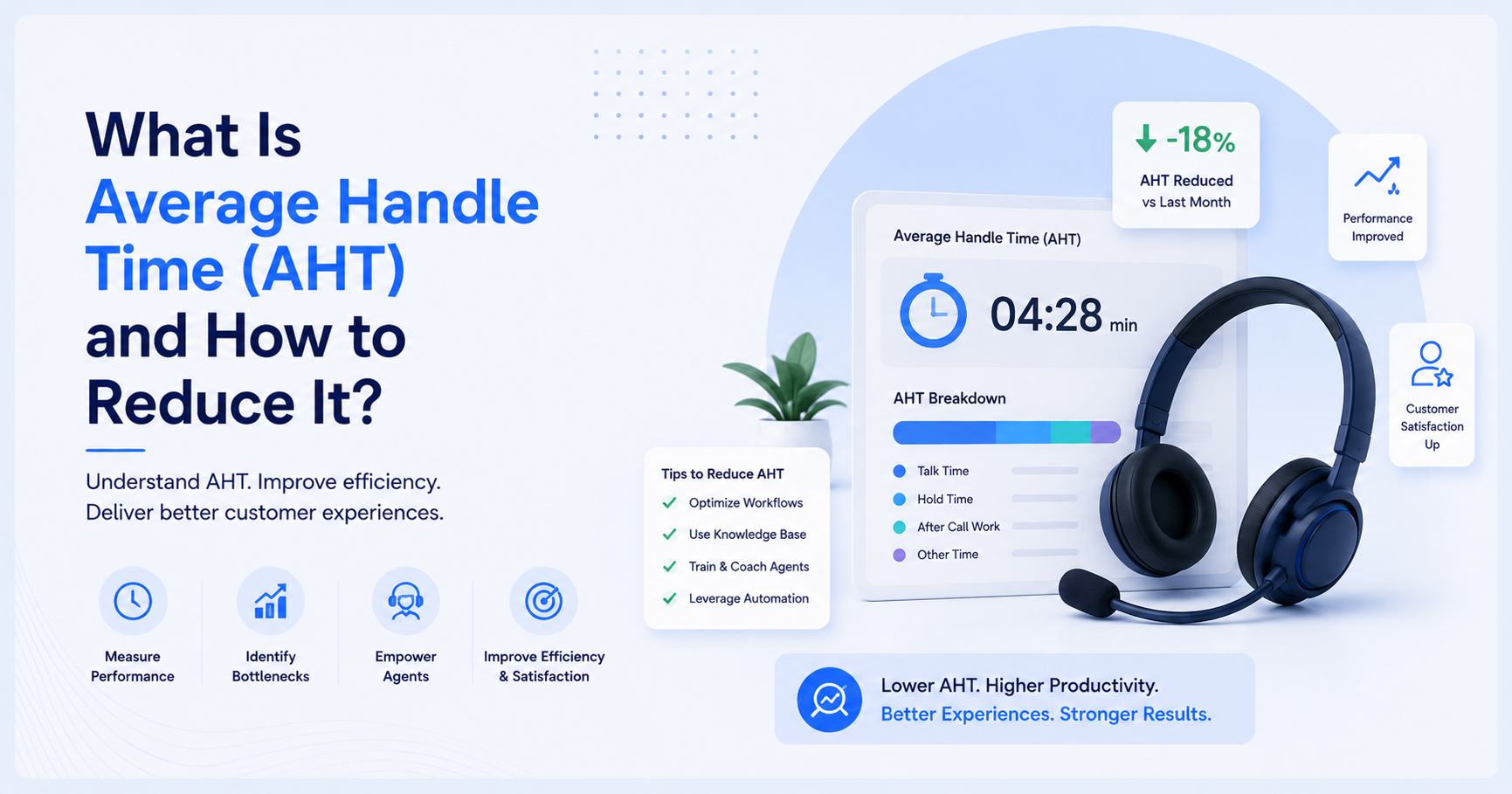
Critically, AHT measures the whole interaction, not just the conversation. It includes three components: the time spent talking with the customer, the time the customer spends on hold or being transferred, and the work the agent does after the customer hangs up. AHT can be measured per agent, per team or department, or across the entire organization.
The Three Components of AHT
Understanding what goes into AHT is the first step to reducing it. Every handle time breaks down into:
- Talk time — the actual time the agent and customer are speaking. The largest and most visible component.
- Hold time — time the customer spends on hold, waiting, or being transferred during the interaction.
- After-call work (ACW) — also called wrap-up time, this is the time after the customer disconnects that the agent spends logging notes, updating the CRM, or sending follow-ups. ACW is often the “silent killer” of AHT, frequently inflated by clunky software and poor processes.
How to Calculate AHT: Formula and Example
The standard, industry-accepted formula is:
AHT = (Total Talk Time + Total Hold Time + Total After-Call Work) ÷ Total Number of Calls
Here’s a worked example. Suppose over one period a contact center recorded:
- Total talk time: 5,000 minutes
- Total hold time: 1,000 minutes
- Total after-call work: 1,500 minutes
- Total calls handled: 625
Adding the three time components gives 7,500 minutes. Dividing by 625 calls gives an AHT of 12 minutes per call.
The same logic applies per agent. If an agent handled 40 calls with 200 minutes of talk, 40 minutes of hold, and 60 minutes of ACW, that’s 300 total minutes ÷ 40 calls = an AHT of 7.5 minutes.
AHT for Chat and Email Channels
AHT isn’t limited to phone calls. The concept adapts to digital channels, though the components shift slightly:
- Chat AHT typically covers active chat time plus any after-chat work, divided by total chats. Agents often handle multiple concurrent chats, which changes how the number is interpreted.
- Email AHT covers the time spent reading, researching, and responding, divided by the number of emails handled.
Because the components differ across channels, AHT should be tracked per channel rather than blended into a single misleading average.
What Is a Good Average Handle Time?
There is no universal “good” AHT — it depends heavily on industry and issue complexity. A commonly cited general benchmark is around six minutes, but this varies enormously: a technical support center handling complex troubleshooting will reasonably have a much higher AHT than a retail line answering simple order questions.
The more important principle is that the right AHT is the one at which agents resolve issues effectively and efficiently. A low AHT paired with low first-call resolution is a warning sign, not a win — it usually means agents are ending interactions before customers’ problems are actually solved. The goal is balance, not the lowest possible number.
Why AHT Matters
AHT is closely watched because it connects directly to both cost and experience. The economics are simple: shorter handle times mean each agent can serve more customers, which reduces labor cost per contact and increases capacity. At scale, even small reductions in AHT generate significant savings. AHT also feeds workforce planning, helping managers forecast how many agents are needed to meet demand.
At the same time, AHT shapes customer experience. Used well, efficient handling means customers get faster help. Used badly — by pushing agents to rush — it erodes resolution quality and satisfaction. That tension is exactly why AHT must be managed alongside quality metrics rather than chased on its own.
How to Reduce Average Handle Time Without Hurting Quality
The safest AHT reductions improve efficiency without pressuring agents to cut corners. Proven methods include:
- Strengthen agent training and onboarding. Well-trained, knowledgeable agents resolve issues faster. Ongoing coaching on efficient-but-empathetic conversation handling is one of the highest-impact levers.
- Reduce agent turnover. Tenured agents have lower handle times than new hires because experience makes them faster, so improving retention naturally lowers AHT.
- Deploy agent-assist technology. Real-time tools that surface relevant information, suggest answers, and guide scripting help agents move efficiently through interactions.
- Build a strong, searchable knowledge base. When agents can find accurate answers instantly, talk and hold time both drop.
- Improve call routing. Routing each contact to the most appropriate, skilled agent reduces transfers, escalations, and repeated explanations.
- Cut after-call work. Streamline post-call processes and fix clunky CRM workflows, since ACW is frequently the most reducible component. Automation and better tooling pay off quickly here.
- Offer self-service to deflect simple contacts. IVR options, chatbots, and AI assistants resolve routine queries before they reach an agent, leaving agents to handle the interactions that genuinely need them.
For more on the technology side, see our guide to the AI tools every call center should be using.
AHT and First Call Resolution: The Balance That Matters
AHT should never be read in isolation. Its most important companion metric is First Call Resolution (FCR) — the share of issues resolved on the first contact. The two must be balanced: driving AHT down while FCR also falls means agents are rushing customers off the line without solving their problems, which increases repeat contacts and frustration. The healthiest contact centers optimize for resolving issues efficiently, treating AHT and FCR (alongside CSAT) as a single balanced scorecard. Our explainers on first call resolution and call center quality assurance cover how these metrics work together.
How Octopus Tech Approaches AHT
Octopus Tech has delivered outsourced call center services from India since 2011, with an emphasis on balancing efficiency and quality rather than optimizing handle time alone. Trained agents, structured quality monitoring, and the right support technology are what allow a contact center to reduce AHT while protecting resolution rates and customer satisfaction. If you’re evaluating how an outsourcing partner manages performance metrics, our guide on how to choose a call center outsourcing partner covers the questions to ask.
Frequently Asked Questions
What is Average Handle Time (AHT)?
Average Handle Time is a call center metric measuring the average total duration of a customer interaction, including talk time, hold time, and after-call work. It is used to assess efficiency, plan staffing, and estimate the cost of serving customers, and can be measured per agent, per team, or organization-wide.
What is the formula for AHT?
The standard formula is: AHT = (Total Talk Time + Total Hold Time + Total After-Call Work) ÷ Total Number of Calls. For example, 7,500 total minutes across 625 calls equals an AHT of 12 minutes per call.
What is a good average handle time?
There is no universal standard, because AHT depends on industry and issue complexity. A commonly cited general benchmark is around six minutes, but complex technical support will run higher and simple retail support lower. A good AHT is one where issues are genuinely resolved efficiently, not simply ended quickly.
What is included in after-call work (ACW)?
After-call work, or wrap-up time, is everything an agent does after the customer disconnects: logging notes, updating the CRM, sending follow-up emails, and completing any required documentation. It’s part of AHT and is often the most reducible component, since clunky software and inefficient processes tend to inflate it.
How can a call center reduce AHT?
Effective methods include better agent training and coaching, reducing turnover so more agents are experienced, deploying real-time agent-assist tools, building a strong searchable knowledge base, improving call routing to reduce transfers, streamlining after-call work, and offering self-service options to deflect simple queries — all without pressuring agents to rush.
Why shouldn’t AHT be reduced too aggressively?
Cutting AHT too far pushes agents to end interactions before issues are fully resolved, which lowers first-call resolution and customer satisfaction and drives more repeat contacts. AHT should be balanced against FCR and CSAT so efficiency gains don’t come at the expense of actually solving customer problems.
Does AHT apply to chat and email support?
Yes. AHT adapts to digital channels: chat AHT covers active chat plus after-chat work, and email AHT covers reading, researching, and responding. Because the components differ by channel, AHT should be tracked separately per channel rather than blended into one average.
Balancing Speed and Quality
Average Handle Time is one of the most useful efficiency metrics a contact center has — it drives staffing, controls cost per contact, and influences how quickly customers get help. But its value depends entirely on how it’s used. Reduce AHT through better tools, training, routing, and streamlined after-call work, and you gain efficiency and capacity. Reduce it by rushing agents, and you sacrifice the resolution quality that actually keeps customers loyal. The best contact centers treat AHT as one part of a balanced scorecard alongside FCR and CSAT.
Octopus Tech provides outsourced call center services from India built around that balance of efficiency and quality. If you’d like to discuss how a metrics-driven support partner can improve your performance, get in touch for a no-obligation conversation.