What Is Workforce Management (WFM) in a Call Center?
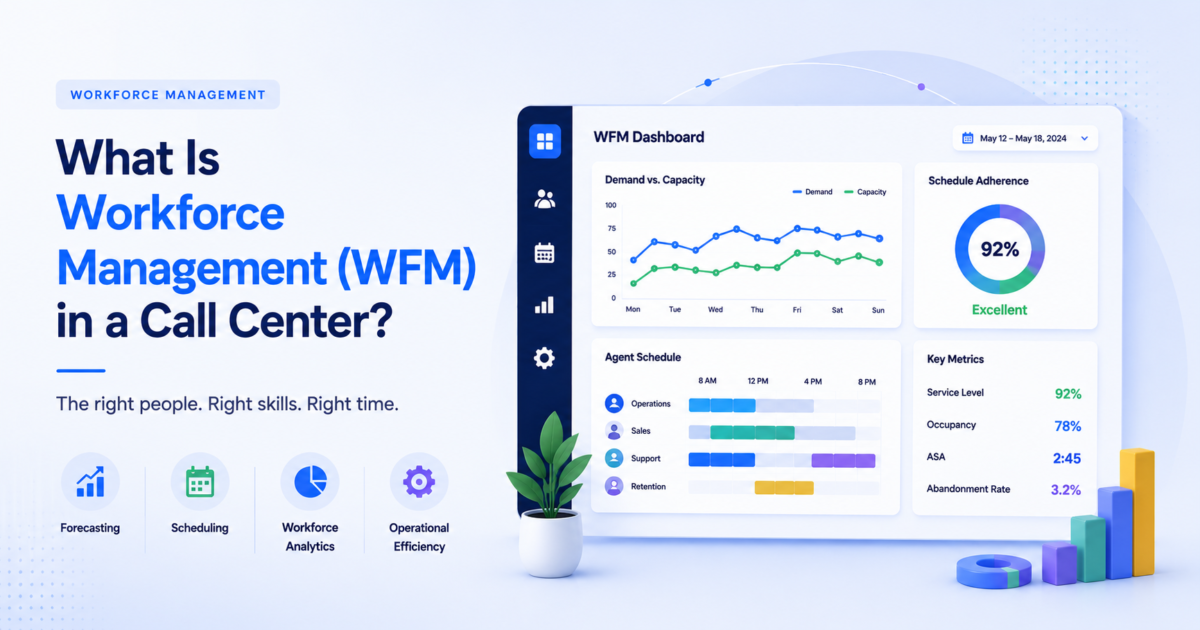
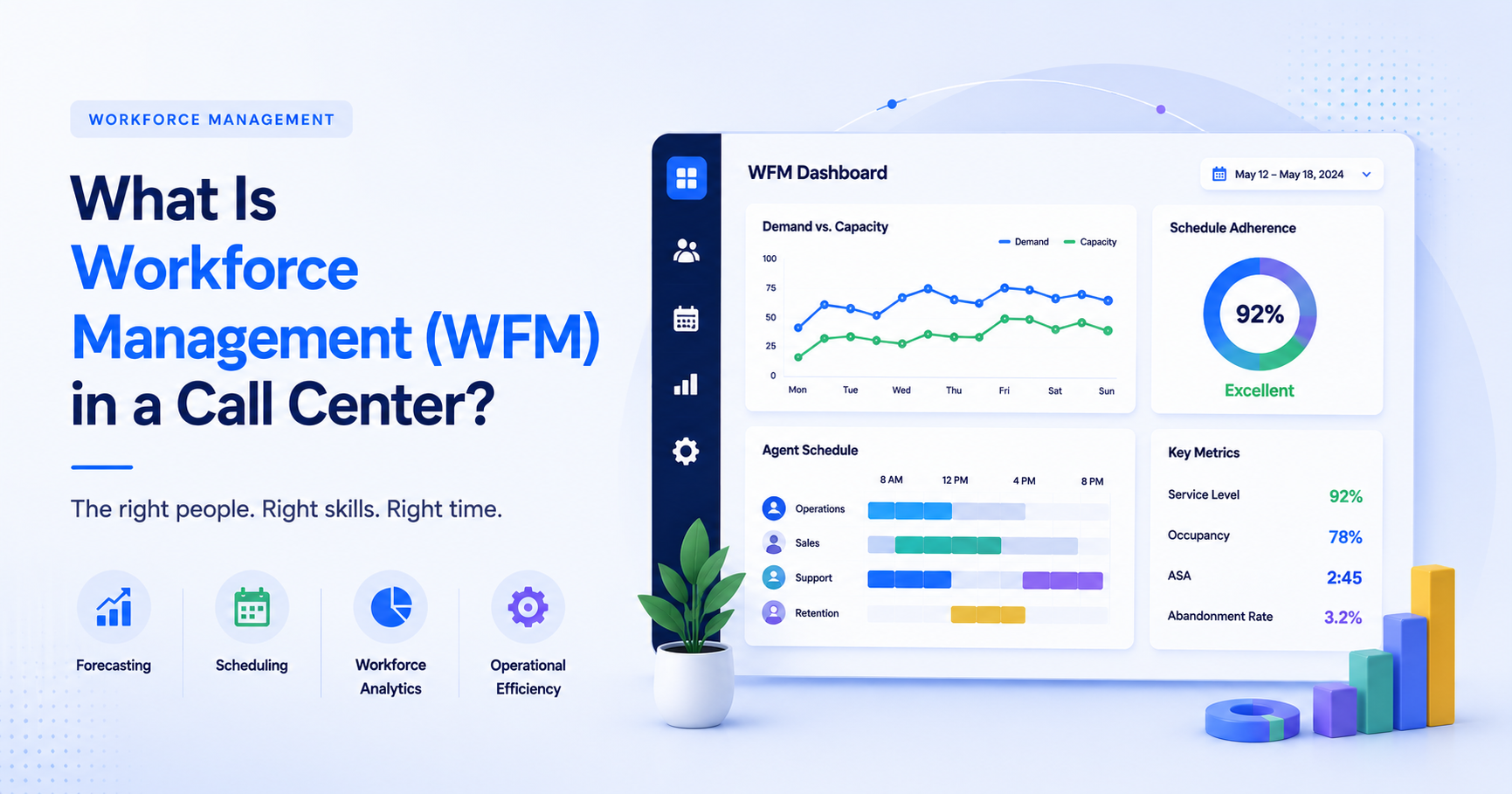
Workforce management (WFM) in a call center is the process of forecasting customer demand, scheduling the right number of agents with the right skills to meet it, and managing those staffing levels in real time to hit service targets at the lowest reasonable cost. In short, WFM ensures the right agents are available at the right time — neither overstaffed (wasting money) nor understaffed (long waits and missed SLAs). It runs as a continuous cycle: forecast demand, build schedules, manage the day as it happens, and analyze performance to improve the next forecast. This guide explains what WFM is, the stages of the WFM cycle, the key metrics involved, and why it matters for both customer experience and cost control.
Key Takeaways
- WFM is the discipline of matching agent staffing to forecasted customer demand, in the right place, time, and skill set.
- It runs as a cycle: forecasting, scheduling, intraday (real-time) management, and performance analysis.
- Done well, WFM controls labor costs, protects service levels (SLAs), and reduces agent burnout simultaneously.
- Core WFM metrics include service level, occupancy, shrinkage, and schedule adherence.
- Modern WFM relies on software and AI to automate forecasting and scheduling, replacing error-prone spreadsheets.
What Is Workforce Management (WFM)?
Workforce management in a call center is the strategic process of aligning agent resources with customer demand. At its core, WFM ensures that the right number of agents, with the right skills, are available at the right time to handle incoming interactions — whether calls, chats, or emails.
It’s much more than building shift rosters. WFM is a system that anticipates how much customer contact is coming, translates that into staffing requirements, creates schedules that meet demand while respecting agent preferences and labor rules, and adjusts in real time when reality differs from the plan. Done well, it balances three things that often pull against each other: operational efficiency, service quality, and agent well-being.
Why Workforce Management Matters
WFM sits at the center of contact-center economics because labor is the largest cost and staffing decisions directly shape customer experience. Get it wrong in one direction — overstaffing — and you waste money on idle agents. Get it wrong in the other — understaffing — and customers face long wait times, service levels slip, and agents burn out under pressure.
Effective WFM solves this balancing act. It controls labor costs by matching staffing precisely to demand, protects service-level agreements so customers get timely help, and supports agent well-being by creating fair, sustainable schedules and avoiding chronic understaffing. For a contact center, strong WFM is what turns staffing from a daily firefight into a predictable, strategic system.
The Workforce Management Cycle
WFM operates as a continuous, repeating cycle. Each stage feeds the next, and the results loop back to improve future planning.
1. Forecasting Demand
Forecasting is the starting point of any workforce plan — you can’t build a useful schedule without knowing how much coverage you’ll need. Demand forecasting predicts future contact volume primarily from historical data, tracking inbound interactions across days, weeks, months, and years, then segmenting by time of day, day of week, and channel for greater precision. Good forecasts also factor in non-historical drivers like seasonality, promotions, product launches, and sales events.
2. Scheduling
Once demand is forecast, the next step is translating it into staffing — assigning agents to shifts, skills, and queues so coverage matches predicted volume. Strong scheduling balances multiple interests at once: the forecasted demand, agent availability and preferences, required skill sets per queue, labor rules, and cost targets. Schedules typically cover the next several weeks and must include the right mix of new and tenured agents to deliver consistent service.
3. Intraday (Real-Time) Management
No forecast is perfect, so WFM includes managing the day as it actually unfolds. Intraday management means watching real-time metrics — queue length, agent status, schedule adherence, and live volume — and making quick adjustments when reality diverges from the plan. That can mean reassigning agents, shifting breaks, or calling in extra coverage to handle unexpected absences or volume spikes and keep service levels stable.
4. Performance Analysis
After the fact, WFM analyzes how the plan performed against reality: where forecasts were accurate, where staffing fell short or ran long, and how service levels held up. These insights feed directly back into the next forecast, making the whole cycle progressively more accurate over time.
Key WFM Metrics Explained
Workforce management relies on a handful of specific metrics. Understanding them is essential to understanding WFM:
- Service level — the percentage of contacts answered within a target time (for example, 80% of calls answered within 20 seconds). It’s the primary measure of whether staffing is meeting demand.
- Occupancy — the proportion of an agent’s logged-in time spent actively handling contacts versus waiting for them. High occupancy signals efficiency but, if sustained too high, drives burnout.
- Shrinkage — the percentage of paid agent time not spent available for contacts, due to breaks, training, meetings, absences, and other activities. Forecasting must account for shrinkage, or schedules will fall short of real coverage needs.
- Schedule adherence — how closely agents follow their assigned schedules (being available when they’re scheduled to be). Low adherence undermines even a perfect schedule.
Tracking these together gives managers a single, reliable view of whether the operation is properly staffed and running efficiently.
WFM Software and the Role of AI
Traditionally, managers juggled forecasting and scheduling with spreadsheets and calendars — slow, labor-intensive, and prone to human error. Because manual forecasting is so arduous, spreadsheet-reliant teams often update forecasts and schedules infrequently, which leaves the contact center exposed to over- or understaffing in between.
Modern WFM software automates these tasks, pulling in historical data to generate forecasts, build schedules, and monitor adherence in real time across multiple channels and locations. Increasingly, AI and automation enhance this further — improving forecast accuracy, automating routine scheduling requests, generating analytics, and providing real-time performance insights. The payoff is that planners spend less time on manual calculation and more on the judgment calls that actually need a human. For more on the technology layer, see our guide to the AI tools every call center should be using.
How WFM Connects to Call Center Performance
WFM doesn’t operate in isolation — it underpins the metrics that define a contact center’s performance. Accurate forecasting and scheduling are what make it possible to consistently hit SLAs, and proper staffing directly affects efficiency measures like average handle time and outcomes like first call resolution. Understaffing inflates wait times and pressures agents into rushing; the right WFM keeps the whole operation balanced so efficiency and quality reinforce each other rather than compete.
How Octopus Tech Approaches Workforce Management
Octopus Tech has delivered outsourced call center services from India since 2011, including the ability to scale staffing for seasonal peaks and fluctuating demand. Sound workforce management — accurate forecasting, disciplined scheduling, and real-time adjustment — is part of what allows an outsourcing partner to meet service levels reliably while keeping costs efficient. If you’re evaluating how a partner plans and manages staffing, our guide on how to choose a call center outsourcing partner covers the questions to ask about capacity and scalability.
Frequently Asked Questions
What is workforce management (WFM) in a call center?
WFM is the process of forecasting customer demand, scheduling the right number of skilled agents to meet it, and managing staffing in real time to hit service targets at the lowest reasonable cost. It ensures the right agents are available at the right time, avoiding both overstaffing and understaffing.
What are the main stages of the WFM cycle?
The WFM cycle has four main stages: forecasting demand (predicting contact volume from historical and other data), scheduling (assigning agents to shifts and skills to meet that demand), intraday or real-time management (adjusting staffing live as the day unfolds), and performance analysis (reviewing results to improve the next forecast).
What is shrinkage in workforce management?
Shrinkage is the percentage of paid agent time not spent available to handle contacts — including breaks, training, meetings, and absences. Forecasts must account for shrinkage, because scheduling only for raw contact volume without it leaves the center understaffed against real coverage needs.
What is occupancy in a call center?
Occupancy is the proportion of an agent’s logged-in time spent actively handling contacts rather than waiting for the next one. Higher occupancy indicates efficient use of staffing, but consistently high occupancy leads to agent fatigue and burnout, so it must be balanced.
What is schedule adherence?
Schedule adherence measures how closely agents follow their assigned schedules — being logged in and available when they’re scheduled to be. Even a well-built schedule fails if adherence is low, which is why it’s a key WFM metric to monitor.
Why is WFM important for a call center?
WFM directly controls the largest cost in a contact center (labor) while protecting customer experience. Good WFM matches staffing to demand so service levels are met without overspending, and it supports agent well-being through fair, sustainable scheduling — turning staffing from a daily scramble into a predictable system.
Does WFM use AI and software?
Yes. Modern WFM relies on software that automates forecasting, scheduling, and real-time adherence monitoring across channels, replacing error-prone spreadsheets. AI increasingly improves forecast accuracy, automates routine scheduling tasks, and surfaces real-time insights, freeing planners to focus on higher-value decisions.
Getting Staffing Right, Every Time
Workforce management is the engine that keeps a contact center properly staffed — accurately forecasting demand, building schedules that match it, adjusting in real time, and learning from the results. Done well, it achieves what can seem contradictory: lower costs, stronger service levels, and healthier, less burned-out agents all at once. It’s also the foundation beneath nearly every other performance metric, from service level and AHT to first call resolution.
Octopus Tech provides outsourced call center services from India with the workforce planning and scalability to meet demand reliably through peaks and quiet periods alike. If you’d like to discuss how a well-managed support partner can keep your service levels high and costs controlled, get in touch for a no-obligation conversation.