In-House Multilingual Agents vs. Interpretation vs. AI Translation
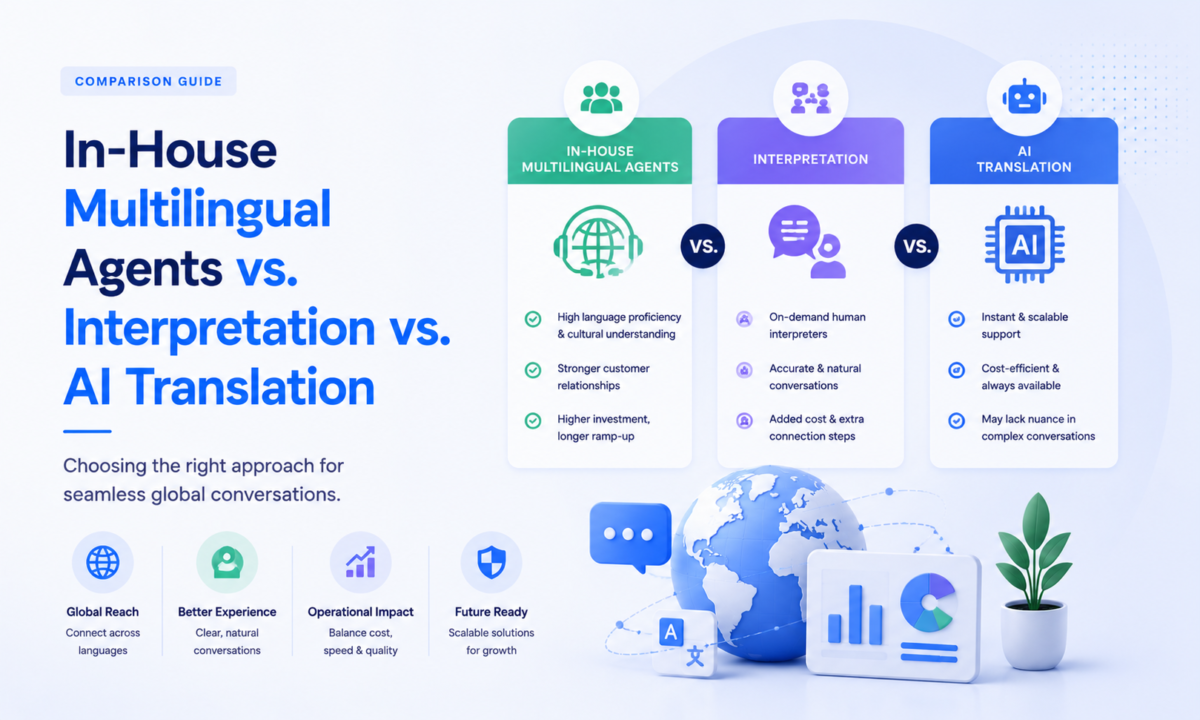
There are three ways to deliver multilingual customer support, and most operations use a blend of all three. Dedicated bilingual agents are native or fluent speakers who handle interactions directly — the highest quality and the highest cost, best for your highest-volume languages. Interpretation (over-the-phone interpretation, or OPI) connects an agent to an on-demand human interpreter, giving broad coverage across hundreds of languages on a pay-per-use basis — best for the long tail of lower-volume languages. AI / real-time translation auto-translates between agent and customer, offering the fastest, most scalable, lowest marginal cost — best for routine, lower-risk interactions. The right answer for most businesses isn’t one model but a hybrid that matches each language and interaction type to the most effective approach. This guide compares the three and gives you a framework to choose.
Key Takeaways
- Dedicated bilingual agents deliver the best quality and cultural fluency but cost the most — reserve them for high-volume, high-stakes languages.
- Interpretation (OPI) offers instant, pay-per-use access to human interpreters across hundreds of languages — ideal for the long tail.
- AI translation is the fastest and most scalable option at the lowest marginal cost, best suited to routine, lower-risk interactions.
- The 2026 best practice is a hybrid: dedicated agents for top languages, OPI for edge cases, and AI for routine volume.
- Match the model to the language volume and interaction sensitivity, not to a one-size-fits-all preference.
The Three Models at a Glance
| Dedicated Bilingual Agents | Interpretation (OPI) | AI / Real-Time Translation | |
|---|---|---|---|
| How it works | Native/fluent agents handle the interaction directly | Agent connects to an on-demand human interpreter | Software translates between agent and customer in real time |
| Quality & cultural fluency | Highest | High (human interpreter) | Improving; varies by use case |
| Language breadth | Limited to languages you staff | Very broad (hundreds of languages) | Broad, but stronger in text than voice |
| Cost model | Highest; fixed per agent | Pay-per-use (per minute) | Lowest marginal cost; subscription/usage |
| Speed to deploy | Slowest (recruit & train) | Fast (on-demand) | Fastest |
| Best for | High-volume, high-stakes languages | Long-tail & edge-case languages | Routine, lower-risk, high-volume interactions |
Option 1: Dedicated Bilingual Agents
Dedicated bilingual agents are native or fluent speakers who handle customer interactions directly in the target language. This is the gold standard for quality: a skilled human agent brings not just language but cultural fluency, tone, empathy, and product knowledge to the conversation, which matters most for complex, sensitive, or brand-defining interactions.
The trade-off is cost and flexibility. Hiring native speakers is the most expensive approach, and it’s the slowest to scale — you have to recruit, train, and retain agents for each language. As a US reference point, dedicated bilingual agents are commonly benchmarked in the range of several thousand dollars per full-time agent per month, well above interpretation or AI on a per-language basis (offshore delivery, such as from India, lowers this substantially).
Best for: your highest-volume languages, and any interaction where quality, nuance, and brand experience are paramount — for example, a business with a large Spanish-speaking customer base staffing dedicated Spanish agents.
Option 2: Interpretation (Over-the-Phone Interpretation / OPI)
Interpretation services connect a call-center agent to an on-demand human interpreter who bridges the conversation in real time. OPI has been an established part of customer service since the 1980s, and the largest providers offer coverage across hundreds of languages — often connecting to an interpreter within seconds.
The strength of OPI is breadth and flexibility without fixed cost. You don’t staff agents for every language; instead you pay per minute only when you need an interpreter, which makes it ideal for the “long tail” of lower-volume or unpredictable languages. As a US reference point, OPI is commonly benchmarked around a per-minute rate, so cost scales directly with usage rather than headcount.
The trade-offs are a slightly less seamless experience (a three-way conversation through an interpreter) and per-minute costs that can add up for high-volume languages, where a dedicated agent would be more economical.
Best for: the long tail of languages you can’t justify staffing, edge-case and low-frequency requests, and broad coverage as a safety net across hundreds of languages.
Option 3: AI / Real-Time Translation
AI translation uses software to translate between a monolingual agent and a customer in real time — for example, instantly converting an incoming Japanese chat into English for the agent and translating the reply back. It’s the fastest to deploy, the most scalable, and the lowest in marginal cost, letting a business offer support in many languages without hiring language specialists for each.
AI has improved rapidly, but there are important nuances when evaluating it. The strongest solutions reason in the customer’s language rather than simply translating English output, detect and switch languages mid-conversation, and perform consistently across channels. Today, AI is generally stronger in text channels (chat, email) than in voice — multilingual AI voice remains the harder problem and lags dedicated human delivery. As a result, AI is best applied to routine, lower-risk interactions, with a clean path to escalate complex or sensitive cases to a human.
Best for: routine, high-volume, lower-risk interactions; rapid entry into new language markets; and deflecting common queries before they reach an agent.
How to Choose: A Decision Framework
Rather than picking one model, match each language and interaction type to the right approach:
- By language volume. Use dedicated agents for your highest-volume languages, OPI for the long tail, and AI to scale routine coverage.
- By interaction sensitivity. Route complex, emotional, or high-stakes interactions to human agents (dedicated or interpreted); let AI handle routine, transactional queries.
- By speed and budget. If you need to launch a new language fast or on a tight budget, AI gets you live quickly; dedicated agents are a longer, larger investment for languages that justify it.
- By channel. AI performs best in text channels today; lean on human delivery for voice where nuance and accent matter most.
The Winning Approach: A Hybrid Model
The clear best practice in 2026 is to combine all three. A typical hybrid pairs dedicated bilingual teams for the highest-volume languages, on-demand OPI for the long tail of edge-case languages, and AI translation to handle routine interactions and scale efficiently — with human agents always available for the conversations that need them. This optimizes cost and quality simultaneously: you’re not overpaying for dedicated agents in languages that don’t justify them, and you’re not forcing AI to handle interactions it isn’t ready for. Industry practice shows blending dedicated agents with OPI for the long tail can cut per-minute language costs significantly while protecting customer experience. Our complete guide to multilingual call center services covers how to design this blend.
How Octopus Tech Approaches Multilingual Delivery
Octopus Tech has delivered outsourced call center and BPO services from India since 2011, across voice and non-voice channels. Designing the right mix of human agents and supporting technology — matched to each client’s language volumes and interaction types — is central to delivering multilingual support that balances quality and cost. If you’re deciding how to structure multilingual coverage, get in touch to discuss your languages and channels, and see our guide on the AI tools every call center should be using for more on the technology layer.
Frequently Asked Questions
What are the three ways to deliver multilingual customer support?
The three models are dedicated bilingual agents (native or fluent speakers who handle interactions directly), interpretation or OPI (connecting an agent to an on-demand human interpreter), and AI real-time translation (software that translates between agent and customer). Most effective operations use a hybrid of all three.
Are dedicated bilingual agents better than AI translation?
For quality, cultural fluency, and complex or sensitive interactions, dedicated bilingual agents are better — but they cost the most and scale slowest. AI translation is faster, cheaper, and more scalable for routine interactions. The right choice depends on language volume and interaction sensitivity, which is why many operations use both.
What is OPI (over-the-phone interpretation)?
OPI connects a call-center agent to an on-demand human interpreter who bridges the conversation in real time. It provides broad coverage across hundreds of languages on a pay-per-minute basis, making it ideal for lower-volume or edge-case languages where staffing a dedicated agent isn’t practical.
When should I use AI translation for customer support?
AI translation is best for routine, lower-risk, high-volume interactions and for entering new language markets quickly. It’s currently stronger in text channels (chat, email) than in voice, so the best approach is to use it for straightforward queries with a clear path to escalate complex or sensitive cases to a human agent.
Which multilingual support model is most cost-effective?
It depends on volume. Dedicated agents are most cost-effective for high-volume languages; OPI is most cost-effective for the long tail, since you pay per use rather than per headcount; and AI has the lowest marginal cost for routine, high-volume interactions. A hybrid that matches each language to the right model usually delivers the best overall economics.
What is a hybrid multilingual support model?
A hybrid model combines all three approaches — dedicated bilingual agents for top-volume languages, OPI interpretation for the long tail, and AI translation for routine interactions — with human agents available for complex cases. It’s the 2026 best practice because it optimizes cost and quality simultaneously rather than forcing one model to do everything.
Can AI translation replace human agents for multilingual support?
Not entirely. AI handles routine, lower-risk interactions well and is improving quickly, but it lags human agents on complex, sensitive, or emotionally charged conversations and on multilingual voice specifically. The strongest operations use AI to handle volume and scale while keeping human agents for the interactions that require nuance, empathy, and judgment.
Choosing the Right Mix
There’s no single best way to deliver multilingual support — there’s the right model for each language and each type of interaction. Dedicated bilingual agents win on quality for your top languages, interpretation gives you affordable breadth across the long tail, and AI translation delivers speed and scale for routine work. The businesses that get multilingual support right in 2026 aren’t choosing between these options; they’re blending them into a hybrid that matches cost to value at every touchpoint.
Octopus Tech provides outsourced multilingual, multichannel call center services from India, designed around the right balance of human expertise and supporting technology. To discuss the model that fits your languages and budget, get in touch for a no-obligation conversation.